Continental Shelf Freshwater Water Resources and Enhanced Oil Recovery By Low Salinity Water Flooding
Abstract:
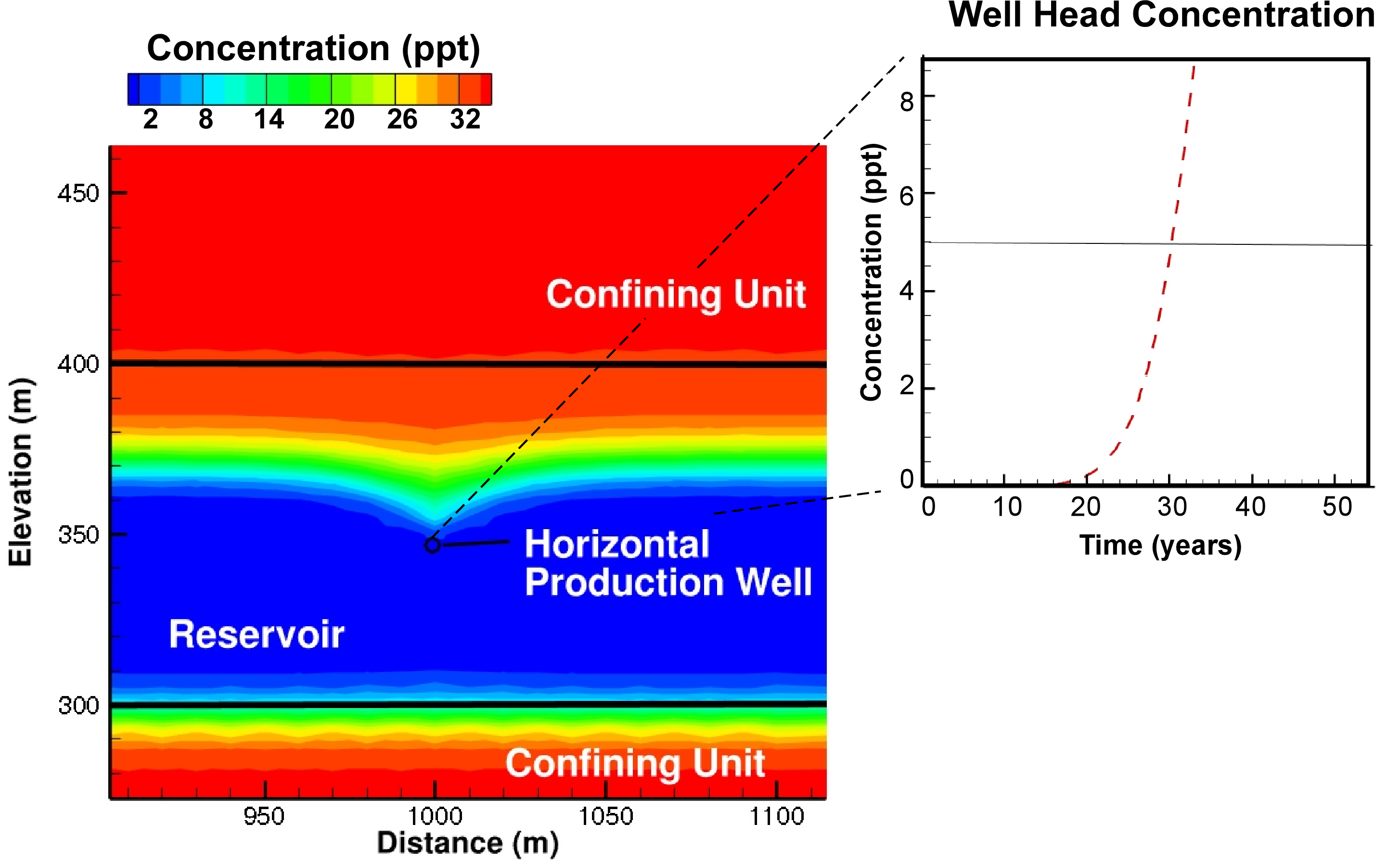
We have analyzed a series of continental shelf cross sections from around the world estimating the average freshwater volume emplaced with distance offshore. We compare the distribution of fresh-brackish water with distance from the coastline to oil platform locations in order to assess the economic viability of this energy-water nexus. We also discuss a project that is currently underway within the North Sea (Clair Ridge) to field validate this concept. We present a series of variable-density groundwater flow and solute transport simulations that are intended to assess how long freshwater resources could be produced in an offshore environment using horizontal drilling technologies before seawater invades the well. We considered a 100m thick freshwater reservoir sandwiched between two 200-300m thick confining units. We pumped the horizontal well at a rate of 5.4 m3/day (1 gpm per meter of well). The resulting drawdown was less than 5 m at the well head (r=0.15 m). For a 1000 m long horizontal well, this resulted in the production of 5455 m3/day of fresh water (over 34,000 barrels per day). Concentrations increased at the wellhead by about 5000 mg/l after 20 years of continuous pumping using a reservoir permeability of 10-13 m2. This simulation demonstrates that where freshwater is available it is likely that it can be produced in commercially viable quantities to support tertiary water floods.