Drip Magmatism: Intra-Plate Volcanism and Its Importance to the Early Earth and Other Terrestrial Planets
Abstract:
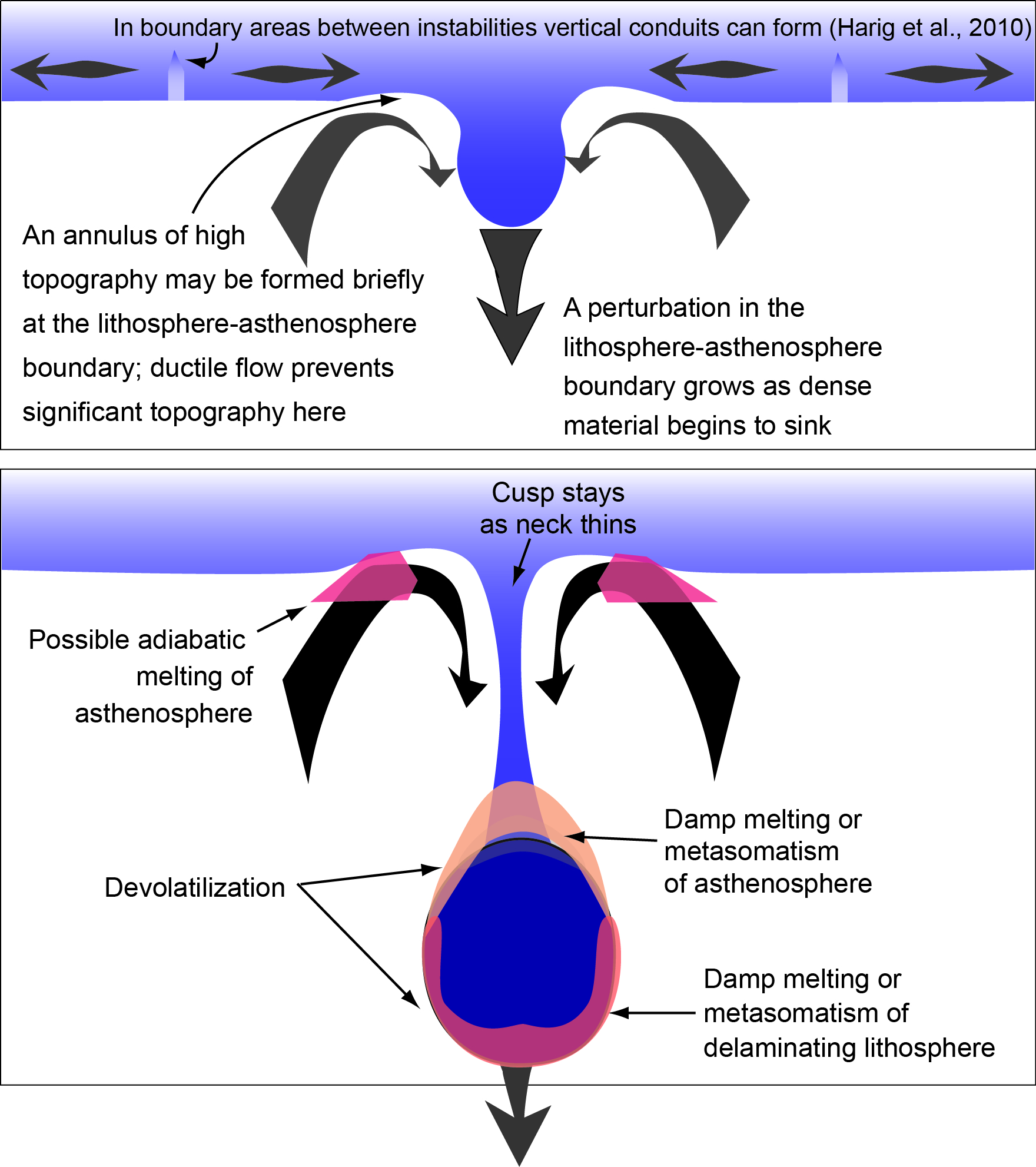
Though its fall may not trigger significant asthenospheric upwelling, the sinking drip itself will heat conductively as it enters the asthenosphere, and may itself melt, depending upon its solidus temperature and the temperature of the asthenosphere. We refer to this as “drip magmatism,” following the hypothesis of Elkins-Tanton (2007). This model produces testable predictions for the resulting magmatic compositions. Drip magmatism was tested by Ducea (2013) for the Altiplano Plateau in the central Andes, by Holbig and Grove (2008) for magmas from Tibet, by Elkins-Tanton (2014) for the Sierra Nevada, and by Furman et al. (2014) for the central African rift; geochemistry in all these localities confirm drip magmatism.
Drip magmatism provides a quantifiable mechanism for slow but regular recycling of volatiles into a planetary atmosphere. Further, it could be driven primarily by carbon, or halogens, or other incompatible and volatile elements, in addition to water. Thus, volcanism on one-plate planets, or during a putative “hot” or “slow” tectonics phase on the early Earth, may provide sufficient volatile recycling for habitability.