A Dynamical Analysis of Present and Future Atmospheric River Behavior over the North Pacific in MERRA Reanalysis and CMIP5 RCP 8.5 Projections
Abstract:
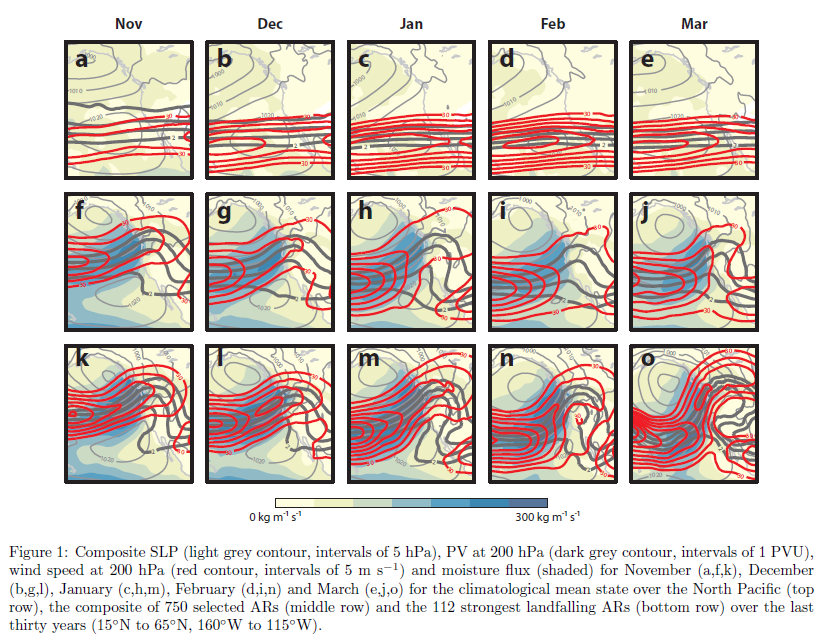
Composites of dynamical fields following the eastward progression of ARs show a close relationship between the location of the jet, Rossby wave propagation and anticyclonic Rossby wave breaking in the upper troposphere of the east Pacific and moisture transport in the lower troposphere (see attached figure). Comparison between the strongest and the weakest ARs show differences in both the intensity of moisture transport and the scale and development of anticyclonic Rossby wave breaking in the east Pacific.
To characterize shifts in AR behavior within the context of projected changes at the end of the century, we extend this line of work using data from 15 different models that participated in CMIP5 and compare our climatology, based on MERRA reanalysis, to daily historical model data (1980 – 2000) and RCP 8.5 (2080 – 2100) projection data. We examine how well ARs are represented in the model output and investigate, within a dynamical context, the role of warming in modifying AR intensity, landfalling latitude and precipitation distribution. We show that while intensity increases are nearly uniform across the models, precipitation and landfalling latitude are quite variable. Here, we focus on the dynamical factors leading to this variability.