Model Selection on Solid Ground: Comparison of Techniques to Evaluate Bayesian Evidence
Abstract:
- Exact analytical solutions are fast, but restricted by strong assumptions.
- Brute-force numerical evaluation is accurate, but quickly becomes computationally unfeasible.
- Approximations known as information criteria (AIC, BIC, KIC) are known to yield contradicting results in model ranking.
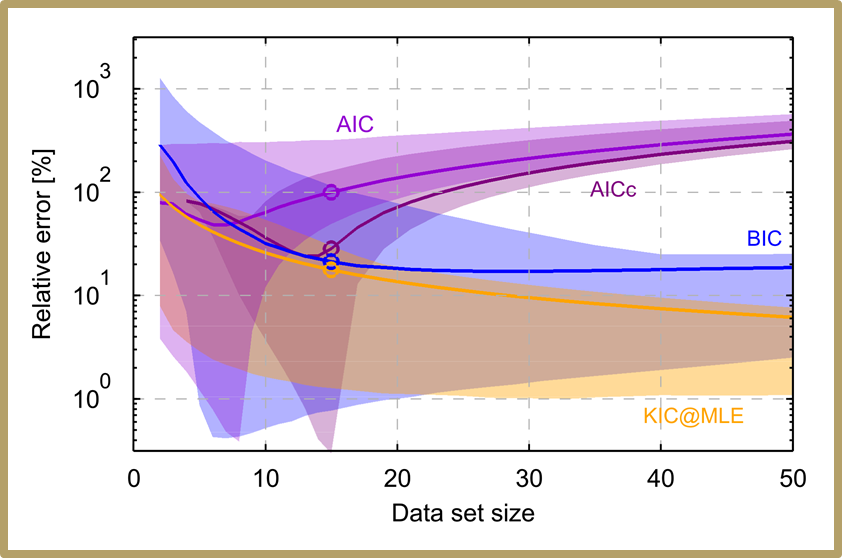
We conduct a systematic comparison of available techniques to evaluate BME, including a list of numerical schemes. We highlight their common features and differences, and investigate their computational effort and accuracy. For the latter, we investigate the impact of (a) data set size and (b) overlap between the prior and the likelihood. We use a synthetic example with an exact analytical solution (as a first-time validation against a true solution), and a real-world hydrological application, where we use a brute-force Monte-Carlo method as benchmark solution.
Our results show that all IC differ drastically in their quality of approximation. From all IC, the KIC evaluated at the MAP performs best, but in general none of them is satisfying for non-linear model problems. Since they share the goodness-of-fit term, the observed differences imply an inaccurate penalty for model complexity. Our findings indicate that the choice of approximation method substantially influences the accuracy of the BME estimate and, consequently, the final model ranking and BMA results.