Aerosol Composition, Size Distribution and Optical Properties during SEAC4RS Simulated by a Sectional Aerosol Model
Aerosol Composition, Size Distribution and Optical Properties during SEAC4RS Simulated by a Sectional Aerosol Model
Abstract:
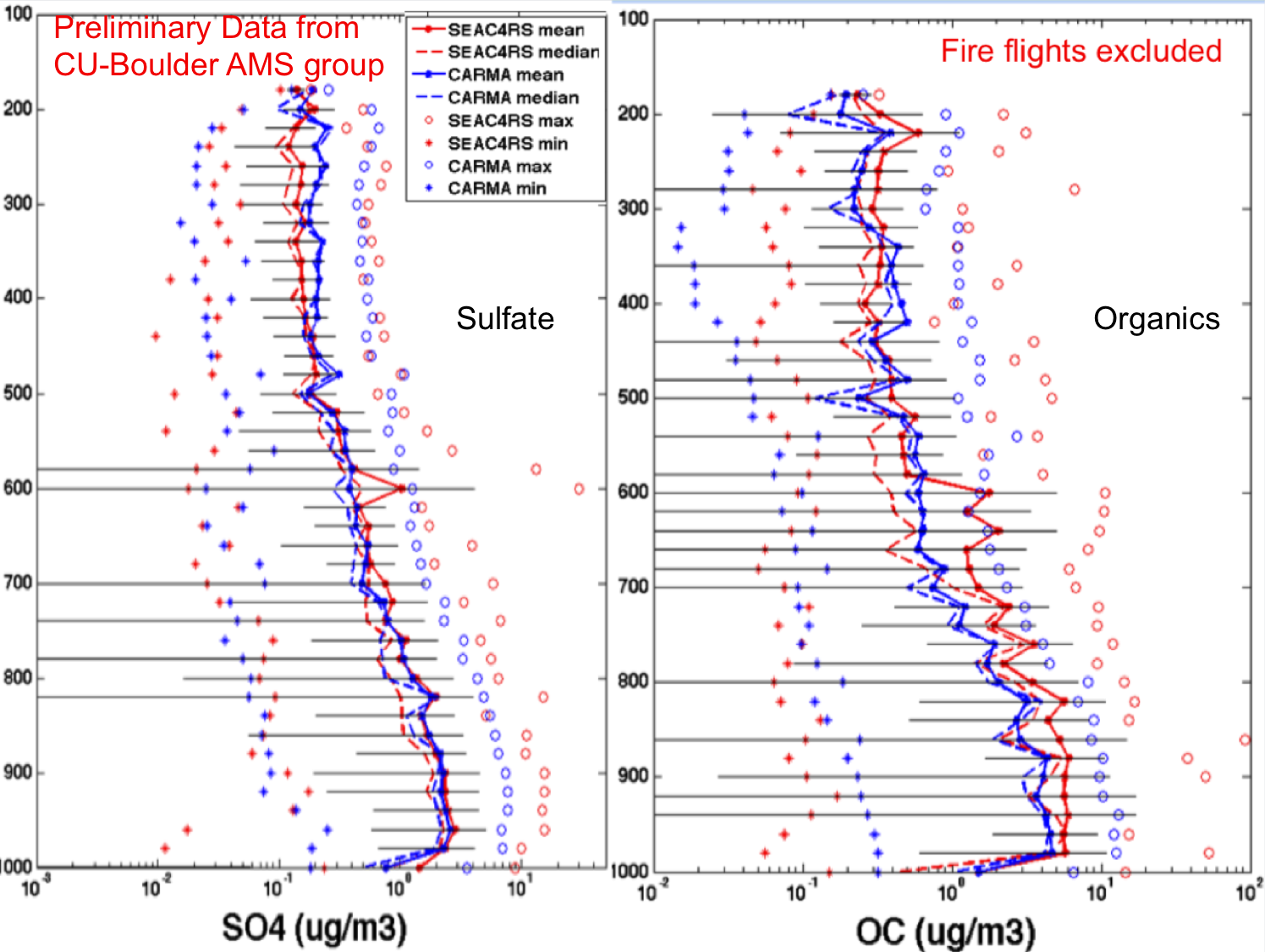
Studies of Emissions and Atmospheric Composition, Clouds and Climate Coupling by Regional Surveys (SEAC4RS) field mission in August and September 2013 provided large aerosol/gas datasets over the Southeastern U.S. We use a sectional microphysics model (CARMA) coupled with CAM-Chem to study the aerosol composition, size distribution, vertical distribution and optical properties during the SEAC4RS campaign. Our simulations are within the observational error bars for the mass of organics, sulfate and black carbon from the boundary layer to upper-troposphere. CARMA, as a sectional model, provides detailed aerosol size distributions from nano-meters to tens of microns, which is important to determine optical properties. We investigate how the aerosol size distribution varies with altitude. Modeled spatial gradients of [O]:[C] and [OC]:[SO4-2] ratios are compared with the AMS and PALMS data collected over forests, fires and cities. These ratios are important to constrain the budget of secondary organic aerosols. We will discuss the values of these ratios over the U.S. and the rest of the world.