Impact of Submesoscale Eddies on Synoptic and Mesoscale Oceanic Structures in a Continental Shelf Margin Analyzed with a Downscaling Ocean Model of Japan Sea
Abstract:
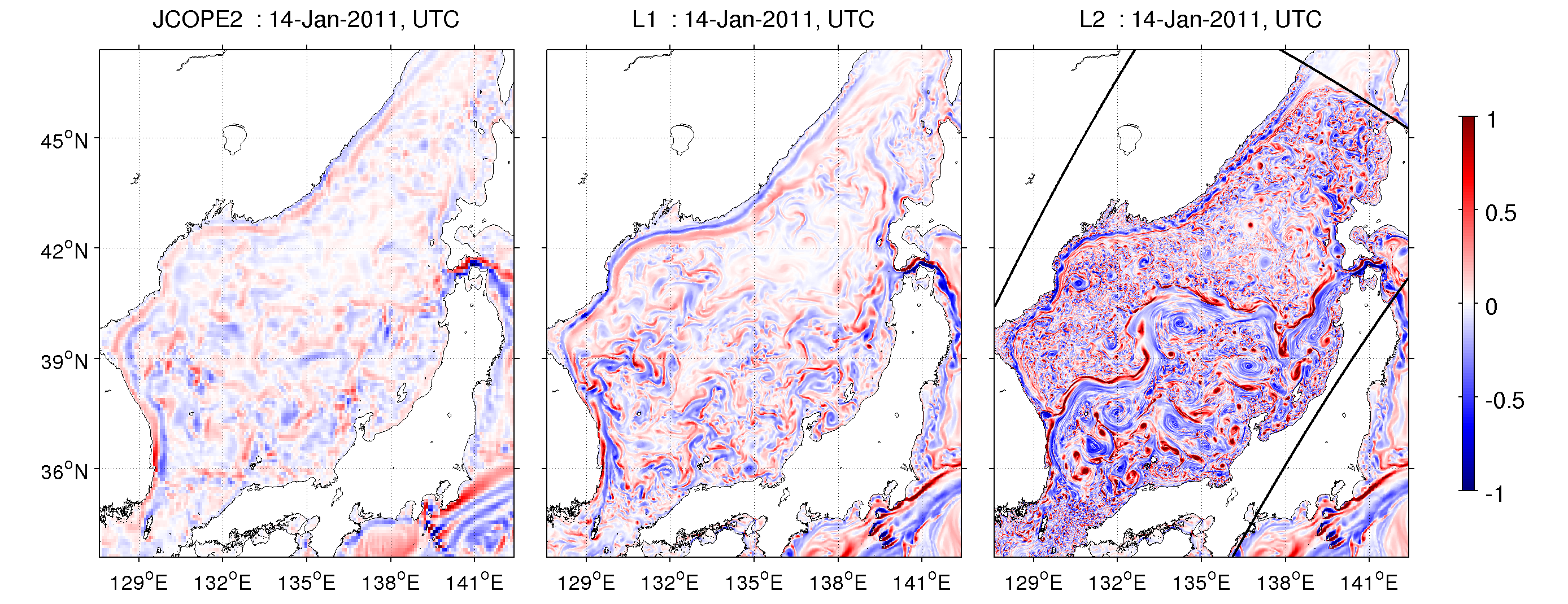
The L1 and L2 models are compared to the observed data to show a good agreement with an appropriate parameter choice. Our models sufficiently reproduce the overall frontal structure and associated major currents in JPS consisting of the Liman Cold Current along the Russian coast and the Tsushima Warm Current along the Japanese coast. Surface normalized relative vorticity fields demonstrate that both the mesoscale and submesoscale eddies are apparently enhanced, as the model grid resolution is finer. In summer and fall, mesoscale eddies are evident in L1 and L2. In contrast in winter and spring, submesoscale eddies are significantly energized in the whole JPS particularly in L2 due to the surface cooling that preconditions symmetric instability (e.g., Thomas et al., 2012). The enhancement of EKE appears around Tsushima strait and along the Korean Peninsula in L1, while EKE in L2 is extensively increased in the most part of the southern JPS. On the other hand, a SSH variance, a proxy of mesoscale variability, is more realistically distributed in L2 than L1, suggesting a potential importance of submesoscale eddies on the mesoscale dynamics.