EMIC waves and associated relativistic electron precipitation on 25-26 January 2013
EMIC waves and associated relativistic electron precipitation on 25-26 January 2013
Abstract:
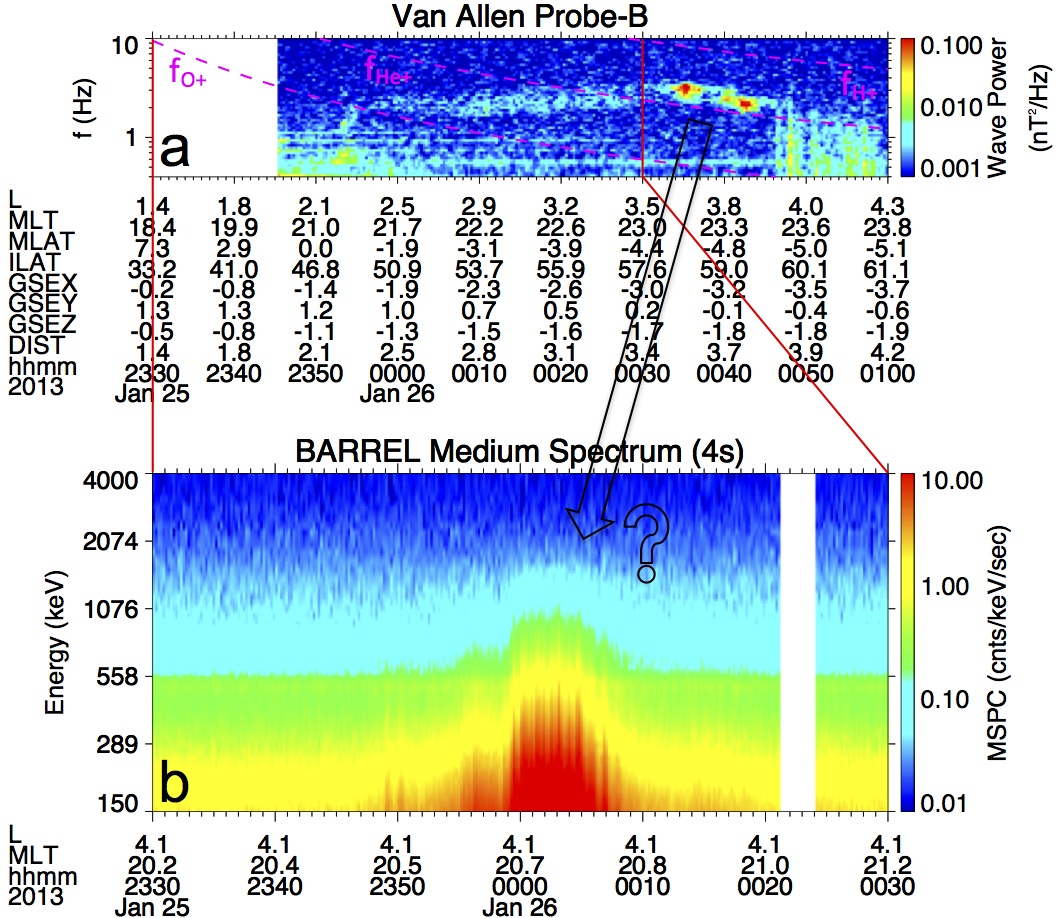
It has been well established that electromagnetic ion cyclotron (EMIC) waves can resonantly interact with relativistic (E > 1 MeV) electrons and result in pitch angle scattering of the electrons. Through this wave-particle resonant interaction, significant electron losses to the atmosphere over some drift orbits are expected. Nevertheless, the direct observation evidence of precipitating electrons by EMIC wave scattering is limited, because the resonant interactions between EMIC waves and relativistic electrons are not fully understood and simultaneously measuring the relativistic electrons at low altitudes and the EMIC waves in the magnetosphere is often difficult. Using measurements from the Van Allen Probes, BARREL, and NOAA/POES, we perform a data-analysis study of EMIC waves and associated relativistic electron precipitation (REP) observed on 25-26 January 2013. The Van Allen Probe-B detected significant EMIC wave activity at L=2.1-3.9 and MLT=21.0-23.4 from 2353 UT, 25 January 2013 to 0046 UT, 26 January 2013. Meanwhile, NOAA/POES and BARREL detected REP events. Particularly, BARREL-1T observed clear precipitation of relativistic electrons at L~4.1 and MLT~20.7 for 33 minutes from 2342 UT, 25 January 2013. The total radiation belt electron content, estimated from local relativistic electron measurements on the Van Allen Probes, also demonstrates internal losses of the electrons around the EMIC wave activity. To further confirm the conjunction of the EMIC waves and REP, we calculate the electron minimum resonant energy (Emin) and pitch angle diffusion coefficient (Dαα) of the EMIC wave packets by using nominal ion composition, derived total ion density from the frequencies of upper hybrid resonance, and measured ambient and wave magnetic field.