Accidental Lessons on Nonlinear Wind - Ocean - Sea Ice Interaction in the Tropics, with Implications for Snowball Earth
Abstract:
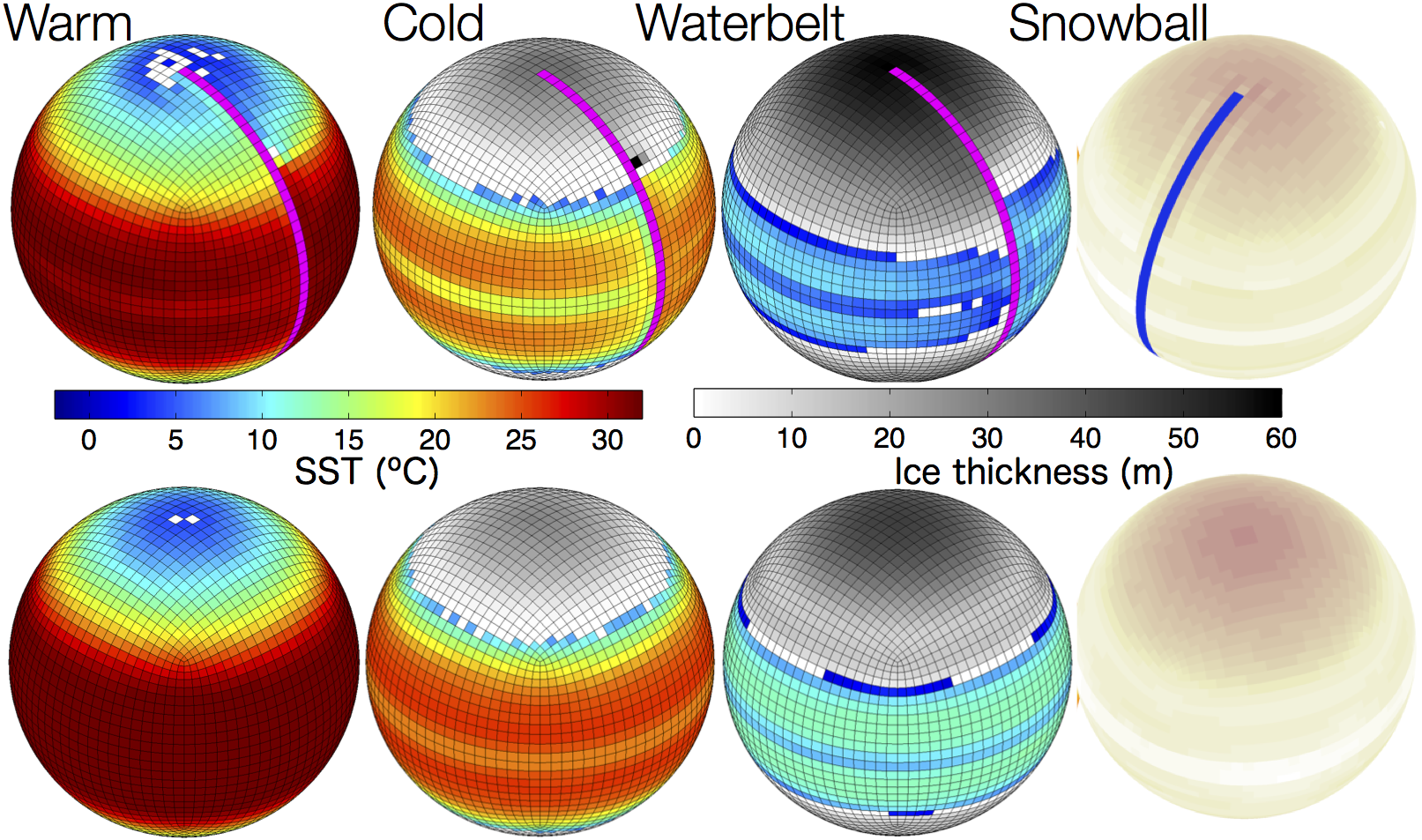
I will discuss the dynamics of the Waterbelt. This climate has no analog in simple albedo feedback theories of climate - ice interaction, yet is stable over a wide parameter range in two different configurations of the numerical model. It is stabilized by a fundamentally coupled atmosphere - ocean - ice dynamical mechanism involving meridional shifts of winds and ocean circulation. The main atmospheric baroclinic zones are roughly coincident with the ice margins, with consequent equatorward contraction of storm tracks and associated surface wind patterns relative to their usual positions. The oceanic thermocline is much shallower and outcrops in the tropics, with an associated vigorous but shallow overturning cell that provides about 100 W m-2 heating at the ice margins. The amplitude of the seasonal cycle of sea ice is very small due to this energetic barrier. The Waterbelt climate is stable in the model over a range of radiative forcing roughly equivalent to 5-6 doublings of CO2. These findings suggest that the initiation of Snowball Earth is a fundamentally coupled problem in which tropical ocean dynamics play a major role.
The multiple equilibria were found through a series of numerical parameter sweeps. In some cases the discoveries were guided by theory and physical intuition; however the Waterbelt discovery was a true ``accident” that has led to new and richer physical insight into the dynamics of very cold climates. I will briefly review the history of these discoveries and argue for more organized exploration of our model parameter spaces.