Spatio-Temporal Dynamics of Urbanization in China: Historical and Future
Spatio-Temporal Dynamics of Urbanization in China: Historical and Future
Abstract:
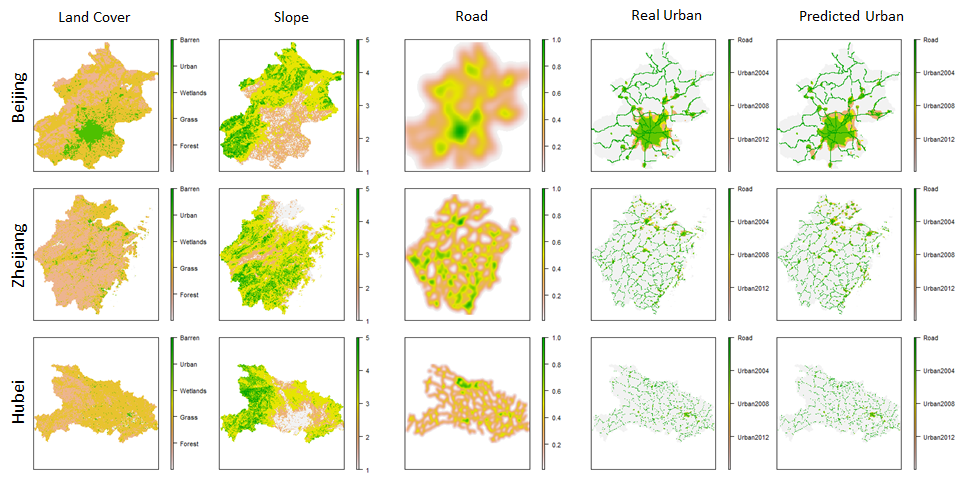
One way humans affect the Earth is by clearing lands and building cities, a process intricately coupled with population growth. The transformation of terrestrial environments by urbanization has been accelerating during the past 30 years. China, for instance, has experienced urbanization at an unprecedented rate, with the urban population increasing from ~20% to 50% between 1980 and 2010. This urban expansion has resulted in a range of environmental and socioeconomic consequences, such as released carbon, reduced habitats, and threatened biodiversity. Improved information on historical and future urbanization is essential to understand these environmental effects, and to promote a sustainable urbanization in China. Supported by urban maps derived from nightlights remote sensing data and socio-economic drivers, we developed an integrated modeling framework to project future urban expansion in China by integrating a top-down macro-scale statistical model with a bottom-up urban growth model (three examples in Figure 1). With the models calibrated and validated using historical data, we explored annual urban growth at the province level and urban sprawl at the grid level (1-km) over the next two decades under a number of socio-economic scenarios. The results of this study will be of great value with practical implications for a sustainable urbanization (e.g. mitigation of urban heat island).