The Reservoir Rock GeoBioCell: A Microfluidic Flowcell Developed for Controlled Experiments on Subsurface Microbe-Water-Rock Interactions
Abstract:
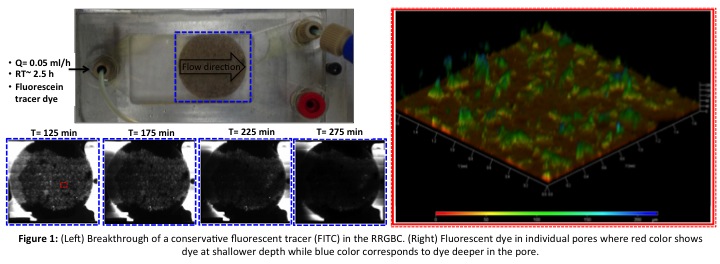
Siliciclastic sandstones core samples of an oil-bearing subsurface reservoir were obtained for construction of the RRGBC. Custom petrographic rock sections (0.5 mm thick) were prepared from these core samples impregnated with Super Glue adhesive. Acetone was then used to remove the Super Glue and physically separate thin sections from the glass slides. A PDMS mold (~3-4 mm thick) was prepared to hold the thin section between a microfluidic inlet and outlet channels. The thin section in PDMS mold was covered with a PDMS-coated glass coverslip to help provide a pressure seal for core thin section (Figure 1, left-top).
Multi-photon laser confocal microscopy of the RRGBC showed pore connectivity to an imaging depth of ~400 µm within the thin section. The geochemical reactive sites were characterized using Raman Backscattering Microscopy, confirming the presence of reactive quartz. A fluorescent tracer test was conducted to identify micro-flow paths and solute breakthrough within the thin section (Figure 1). A multiphase flow experiment was performed to trap residual light oil in the thin section. A mixed-culture of oil-degrading biofilm was developed to degrade the entrapped oil, and an oxygen sensitive fluorophore was used to observe regions of microbial activity. The RRGBC developed in this study is useful for quantitatively testing and monitoring the physical, chemical and biological factors that affect subsurface carbonate diagenesis and other biogeochemical reactions.