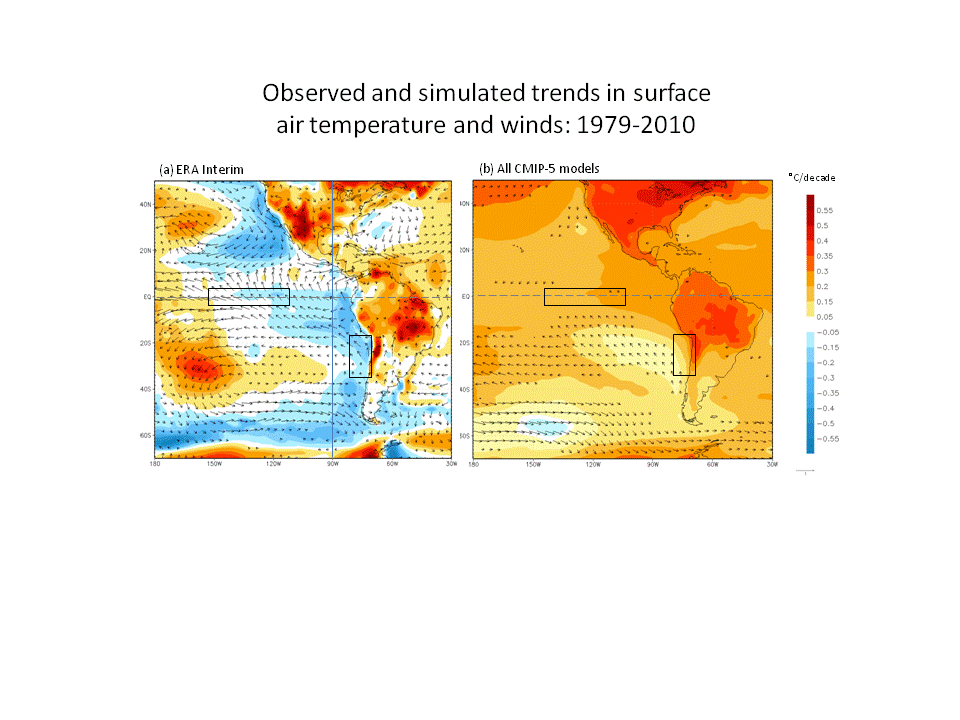
A dynamical negative climate feedback: Surface cooling of the SE Pacific
Abstract:
Considering the CMIP5 historical runs and reanalysis data we show that the cooling trend over the SE Pacific is related with the enhanced anticyclonic circulation in this region but exhibits no correlation with the trends of the trade winds. The reinforced SE Pacific anticyclone -seen both in the reanalysis and models- drives stronger low-level southeasterly winds which can cool the ocean surface through enhanced latent heat flux (evaporation), particularly over the extremely dry SE Pacific.
We finally show that the increase in sea-level-pressure over the southern fringe of the SE Pacific can be associated with the expansion of the Hadley Cell, a trend that has been observed and projected to continue in the future in concert with the increase of greenhouse gas concentrations. Therefore, the resulting cooling over a vast region of the SE Pacific can in turn act as a negative dynamical feedback on global warming. Indeed, the regional anomaly cooling off the west coast of South America appears as a robust feature in future climate prediction that also scale with the greenhouse gas concentrations.