Use of a Chamber to Comprehensively Characterise Emissions and Subsequent Processes from a Light-Duty Diesel Engine
James D Allan1,2, M. Rami Rami Alfarra3,4, James Whitehead5, Gordon McFiggans5, Shaofei Kong5, Roy M Harrison6,7, Mohammed Salim Alam8, Jacqui F Hamilton9, Kelly Louise Pereira9 and Rachel Ellen Holmes9, (1)The National Centre for Atmospheric Science, University of Manchester, Manchester, United Kingdom, (2)University of Manchester, National Centre for Atmospheric Science, Manchester, M13, United Kingdom, (3)Department of Earth and Environmental Sciences, The University of Manchester, Manchester, UK, Manchester, United Kingdom, (4)National Centre for Atmospheric Science, The University of Manchester, Manchester, UK, Manchester, United Kingdom, (5)University of Manchester, School of Earth, Atmospheric and Environmental Sciences, Manchester, United Kingdom, (6)King Abdulaziz University, Department of Environmental Sciences, Faculty of Meteorology, Environment and Arid Land Agriculture, Jeddah, Saudi Arabia, (7)University of Birmingham, Birmingham, United Kingdom, (8)University of Birmingham, Birmingham, B15, United Kingdom, (9)Department of Chemistry, University of York, York, United Kingdom
Abstract:
Around 1 in 3 light duty vehicles in the UK use diesel engines, meaning that on-road emissions of particulates, NO
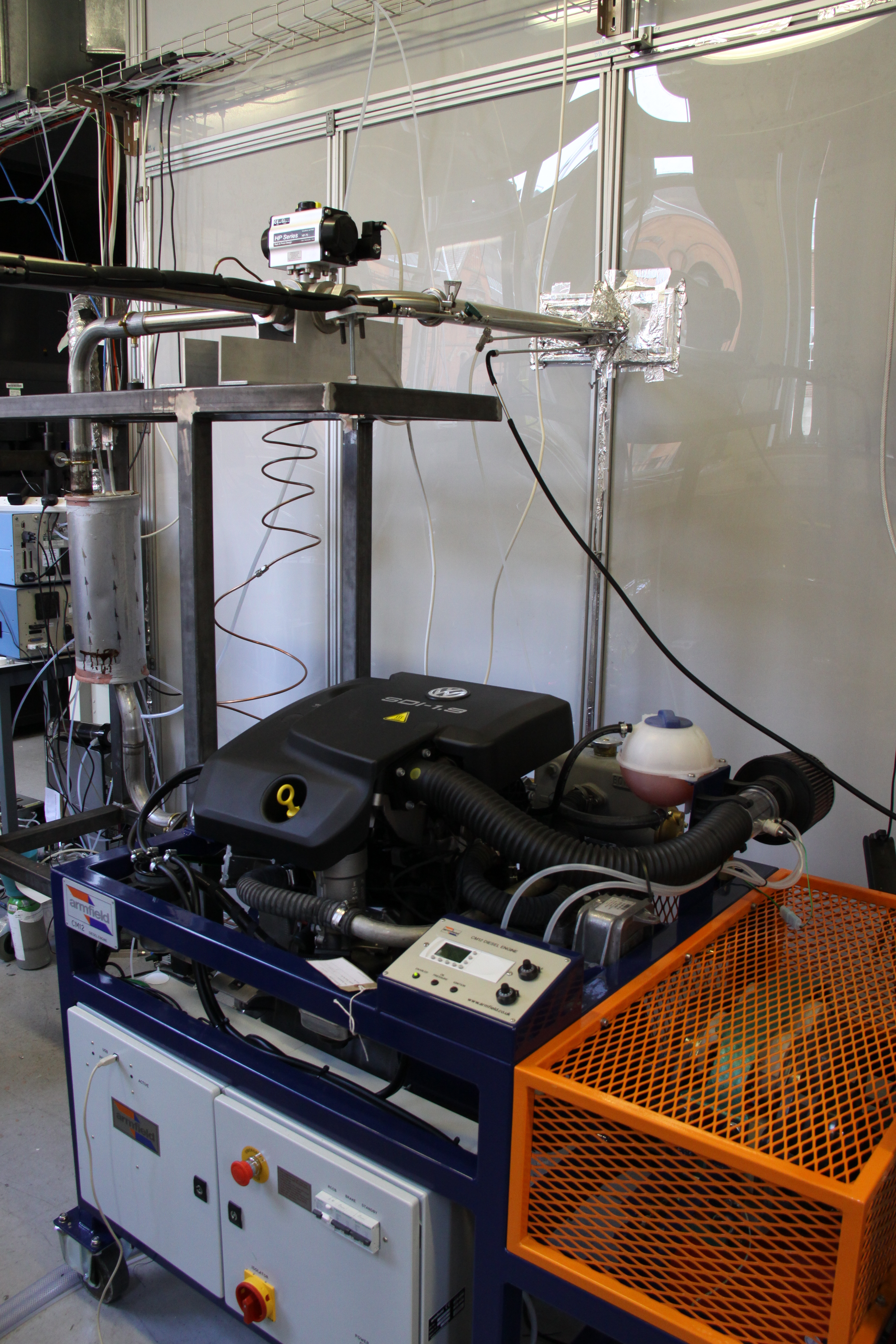
x and VOCs and subsequent chemical processes are substantially different to countries where gasoline engines dominate. As part of the Natural Environment Research Council (NERC) Com-Part project, emissions from a diesel engine dynamometer rig representative of the EURO 4 standard were studied. The exhaust was passed to the Manchester aerosol chamber, which consists of an 18 m
3 teflon bag and by injecting a sample of exhaust fumes into filtered and chemically scrubbed air, a controllable dilution can be performed and the sample held in situ for analysis by a suite of instruments. The system also allows the injection of other chemicals (e.g. ozone, additional VOCs) and the initiation of photochemistry using a bank of halogen bulbs and a filtered Xe arc lamp to simulate solar light.
Because a large volume of dilute emissions can be held for a period of hours, this permits a wide range of instrumentation to be used and relatively slow processes studied. Furthermore, because the bag is collapsible, the entire particulate contents can be collected on a filter for offline analysis. Aerosol microphysical properties are studied using a Scanning Mobility Particle Sizer (SMPS) and Centrifugal Particle Mass Analyser (CPMA); aerosol composition using a Soot Particle Aerosol Mass Spectrometer (SP-AMS), Single Particle Soot Photometer (SP2), Sunset Laboratories OC EC analyser and offline gas- and high performance liquid chromatography (employing advanced mass spectrometry such as ion trap and fourier transform ion cyclotron resonance); VOCs using comprehensive 2D gas chromatography; aerosol optical properties using a Cavity Attenuated Phase Shift Single Scattering Albedo monitor (CAPS-PMSSA), 3 wavelength Photoacoustic Soot Spectrometer (PASS-3) and Multi Angle Absorption Photometer (MAAP); particle hygroscopcity using a Hygroscopicity Tandem Differential Mobility Analyser (HTDMA) and monodisperse Cloud Condensation Nuclei counter (CCN); and measurements of ozone, NOx and CO2. Here we present the first results, where we explored the trends as a function of engine speed, load, exhaust treatment (an oxidizing catalytic converter), dilution factor and exposure to light.