What if we took a global look?
Abstract:
Holistic and multi-scales approaches are becoming more and more common in water sciences research. The intrinsic nature of river systems demands these approaches to account for the upstream-downstream link of watersheds. Before recent technological developments, large scale analyses were cumbersome and, often, the necessary data was unavailable. However, new technologies, both for information collection and computing capacity, enable a high resolution look at the global scale. For rivers around the world, this new outlook is facilitated by the hydrologically relevant geo-spatial database HydroSHEDS. This database now offers more than 24 millions of kilometers of rivers, some never mapped before, at the click of a fingertip.
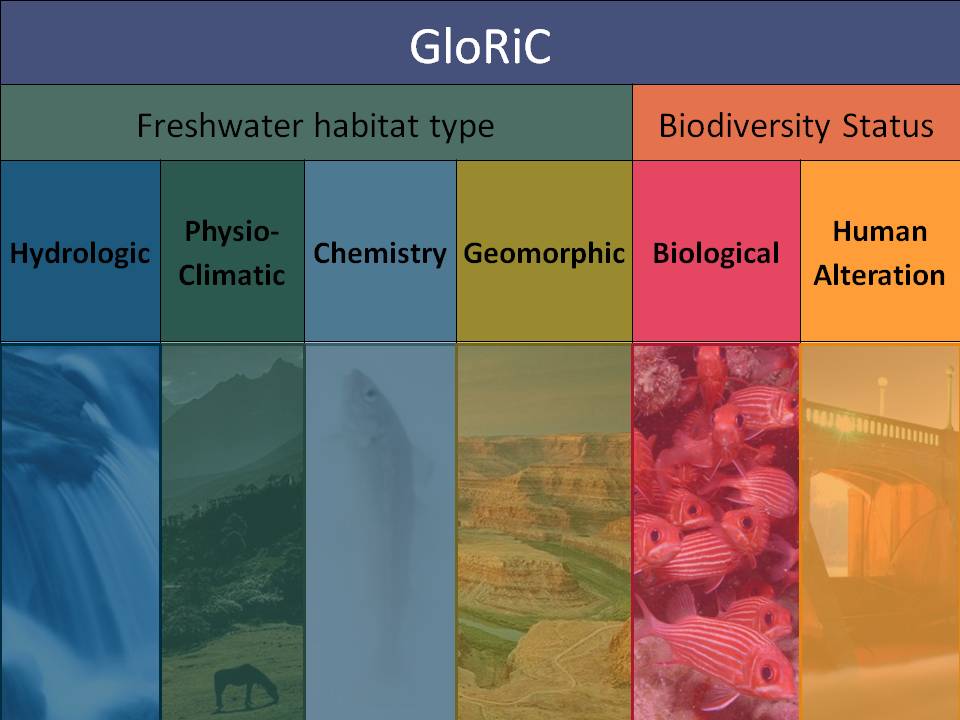
Large and, even, global scale assessments can now be used to compare rivers around the world. A river classification framework was developed using HydroSHEDS called GloRiC (Global River Classification). This framework advocates for holistic approach to river systems by using sub-classifications drawn from six disciplines related to river sciences: Hydrology, Physiography and climate, Geomorphology, Chemistry, Biology and Human impact. Each of these disciplines brings complementary information on the rivers that is relevant at different scales.
A first version of a global river reach classification was produced at the 500m resolution. Variables used in the classification have influence on processes involved at different scales (ex. topography index vs. pH). However, all variables are computed at the same high spatial resolution. This way, we can have a global look at local phenomenon.