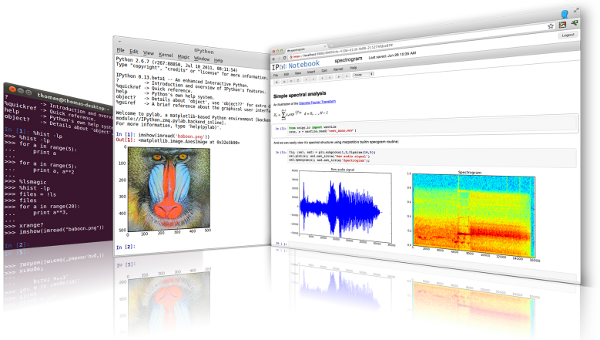
The Jupyter/IPython architecture: a unified view of computational research, from interactive exploration to communication and publication.
Abstract:
The language agnostic parts of IPython have been renamed to Jupyter, to better capture the notion that a cross-language design can encapsulate commonalities present in computational research regardless of the programming language being used. This architecture offers components like the web-based Notebook interface, that supports rich documents that combine code and computational results with text narratives, mathematics, images, video and any media that a modern browser can display. This interface can be used not only in research, but also for publication and education, as notebooks can be converted to a variety of output formats, including HTML and PDF.
Recent developments in the Jupyter project include a multi-user environment for hosting notebooks for a class or research group, a live collaboration notebook via Google Docs, and better support for languages other than Python.