RaInCube: a proposed constellation of precipitation profiling Radars In Cubesat
Abstract:
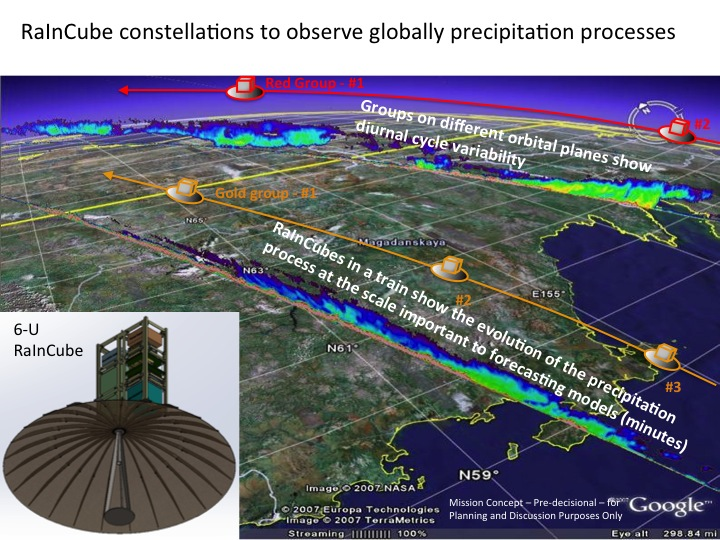
The low cost nature of the RaInCube platform would enable deployment of a constellation of identical copies of the same instrument in various relative positions in LEO to address specific observational gaps left open by the current missions that require high-resolution vertical profiling capability. A constellation of only four RaInCubes would populate the precipitation statistics in a distributed fashion across the globe and across the times of day, and therefore, would enable substantially better sampling of the diurnal cycle statistics.
One could extend this scheme by adding more RaInCubes in each of the orbital planes, and phase them once in orbit so that they would be separated by an arbitrary amount of time among them. Wide separations (say 20-30 min) would further extend the sampling of the diurnal cycle to sub-hourly scales. Narrower time separations between RaInCubes would allow studying the evolution of convective systems at the convective time scale in each region of interest and would reveal the dominant modes of evolution of each corresponding climatological regime.
A constellation of RaInCubes would also be a natural complement to other resources aiming at monitoring the evolution of weather systems, for example the Geostationary IR/VIS imagers, the NEXRAD network, and the GPM constellation.