Where is the equator? A definition based on the atmosphere and its implications for atmospheric chemistry and climate
Abstract:
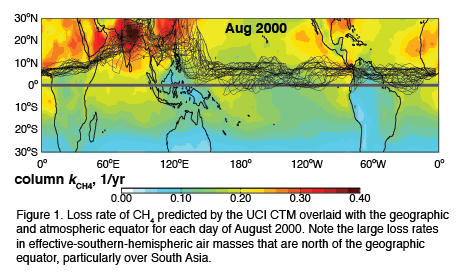
We use artificial tracers in a CTM to define the atmospheric (as opposed to geographic) hemispheres. We show that the tracer definition corresponds with the Intertropical Convergence Zone (ITCZ) where it is well defined and robust against several different tracer definitions. The atmospheric equator lies at 3°N on average (10°N in boreal summer) and extends as far as 30°N during the South Asian summer monsoon (Figure 1). When methane/methylchloroform loss rates are calculated for the dynamic and time-varying hemispheres, the CTM has just 5% greater loss in the northern hemisphere (Figure 1). Thus, using a definition of atmospheric hemispheres that is consistent with atmospheric circulations reveals that OH distributions in CTMs, while still slightly overestimating northern hemisphere OH, are much closer to observational constraints than has been implied by past work. We also discuss the implications of the unequal-sized hemispheres for other problems in atmospheric chemistry. For example, two-box models are commonly used to infer inter-hemispheric air mass exchange times from observations of SF6 or other long-lived gases, but results will be biased if the hemispheric boxes are assumed to have equal sizes.