Observed sea ice thickness changes in the Beaufort Gyre through synthesis of Eulerian and Lagrangian data
Abstract:
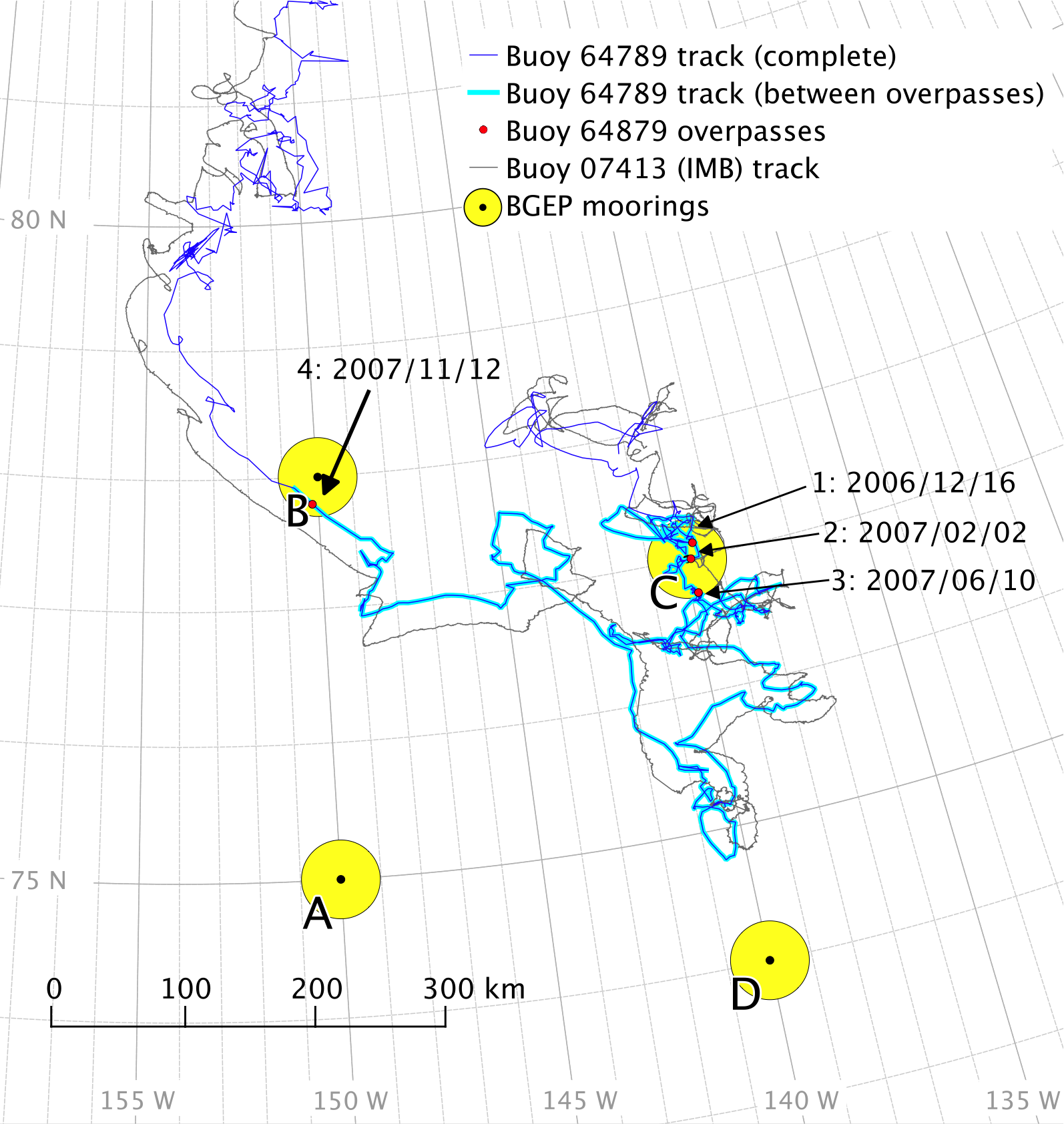
Using a combined Eulerian-Lagrangian approach we identify satellite-tracked buoys that made repeat overpasses within 30 km of four moored ice profiling sonars (IPSs), which comprise part of the Beaufort Gyre Exploration Program (BGEP). Using the IPS data, we derive ice draft distributions corresponding to each of these overpasses, which allows tracking of changes in the ice thickness in vicinity of each buoy. Changes in modal values of ice thickness during winter agree with simple models of thermodynamic growth.In the case of one buoy that made a total of four overpasses (see figure below), a dramatic shift in a secondary modal thickness during the summer of 2007 agrees well the magnitude of melt recorded by a nearby ice mass balance buoy (IMB).
To extend the number of repeat passes, we generate pseudo-Langrangian ice drift tracks using daily gridded fields of satellite-derived ice velocity. This allows us to deploy “numerical buoys” every day anywhere in the Arctic. Using this approach we identify numerous cases where sea ice observed over one mooring persistently drifts over another. Such inter-mooring ice advection events allow us to examine how sea ice thickness distribution in the Beaufort Gyre is influenced by dynamic and thermodynamic processes processes.