Fluid Lensing, Applications to High-Resolution 3D Subaqueous Imaging & Automated Remote Biosphere Assessment from Airborne and Space-borne Platforms
Abstract:
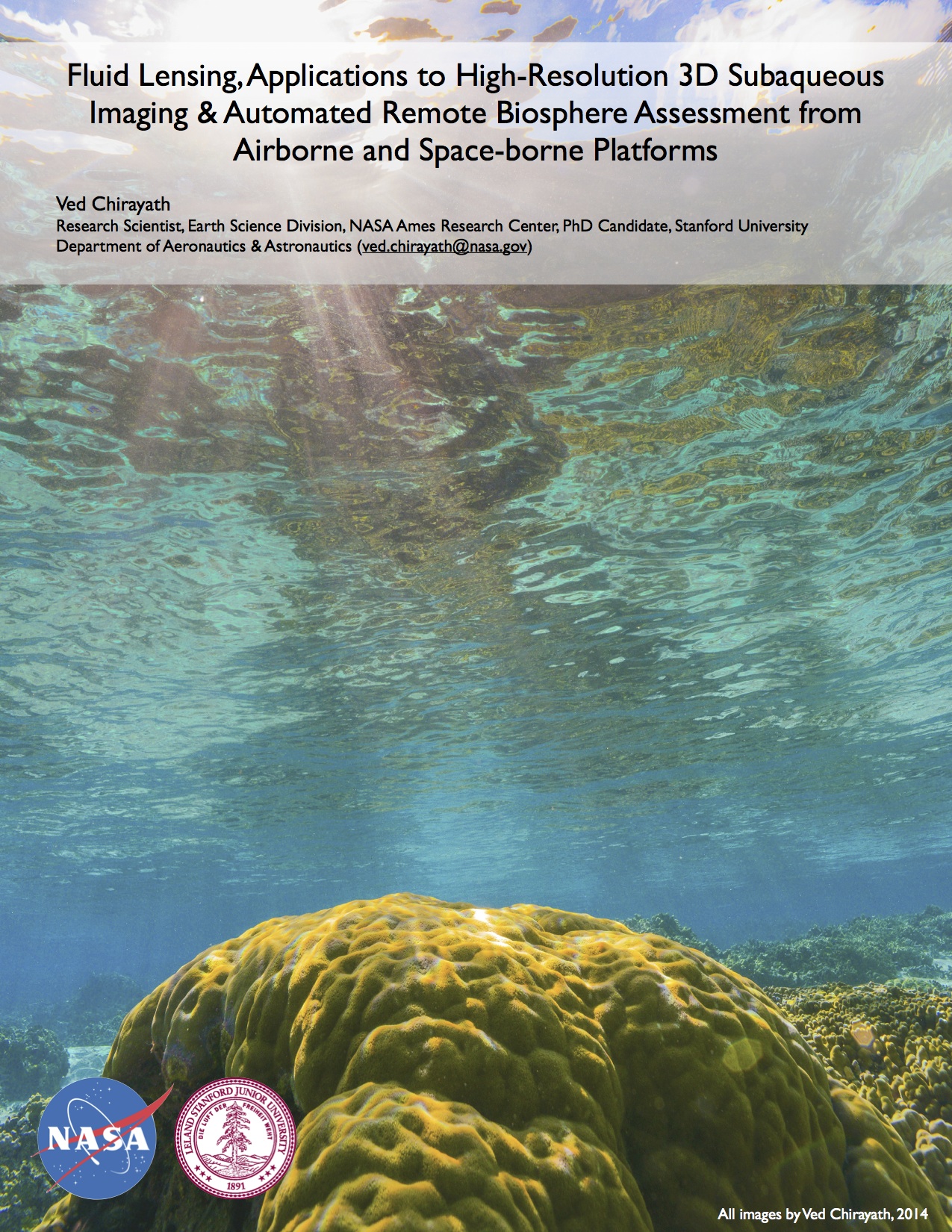
Perturbed two-fluid boundaries with different refractive indices, such as the surface between the ocean and air, may be exploited for use as lensing elements for imaging targets on either side of the interface with enhanced angular resolution. I present theoretical developments behind Fluid Lensing and experimental results from its recent implementation for the Reactive Reefs project to image shallow reef ecosystems at cm scales. Preliminary results from petabyte-scale aerial survey efforts using Fluid Lensing to image at-risk coral reefs in American Samoa (August, 2013) show broad applicability to large-scale automated species identification, morphology studies and reef ecosystem characterization for shallow marine environments and terrestrial biospheres, of crucial importance to understanding climate change's impact on coastal zones, global oxygen production and carbon sequestration.