Ozone Diurnal Variation in the PBL at the Boulder Atmospheric Observatory During Summer 2014
Mike Newchurch1, Raul J Alvarez II II2, Alan Brewer3, Steven S Brown3, William Carrion4, Ruben Delgado5, Russell De Young4, Guanyu Huang6, Bryan Johnson7, Shi Kuang8, Andrew O'Neil Langford2, Julie K Lundquist9, Thomas J McGee10, Denis Pliutau11, Christoph J Senff12, John T Sullivan13, Grant K. Sumnicht10, Larry Twigg10 and Lihua Wang14, (1)Univ of Alabama Huntsville, Huntsville, United States, (2)NOAA ESRL, Boulder, CO, United States, (3)NOAA, Earth System Research Laboratory, Boulder, CO, United States, (4)NASA Langley Research Center, Hampton, VA, United States, (5)Hampton University, Atmospheric and Planetary Sciences, Hampton, VA, United States, (6)Spelman College, Environmental and Health Sciences, Atlanta, United States, (7)NOAA Boulder, ESRL/GMD, Boulder, CO, United States, (8)Univ. of Alabama in Huntsville, Huntsville, AL, United States, (9)University of Colorado Boulder, Atmospheric and Oceanic Sciences, Boulder, United States, (10)NASA Goddard Space Flight Center, Greenbelt, MD, United States, (11)Science Systems and Applications, Inc. Hampton, Hampton, VA, United States, (12)NOAA, Boulder, CO, United States, (13)NASA Goddard Space Flight Center, Greenbelt, United States, (14)University of Alabama in Huntsville, Huntsville, AL, United States
Abstract:
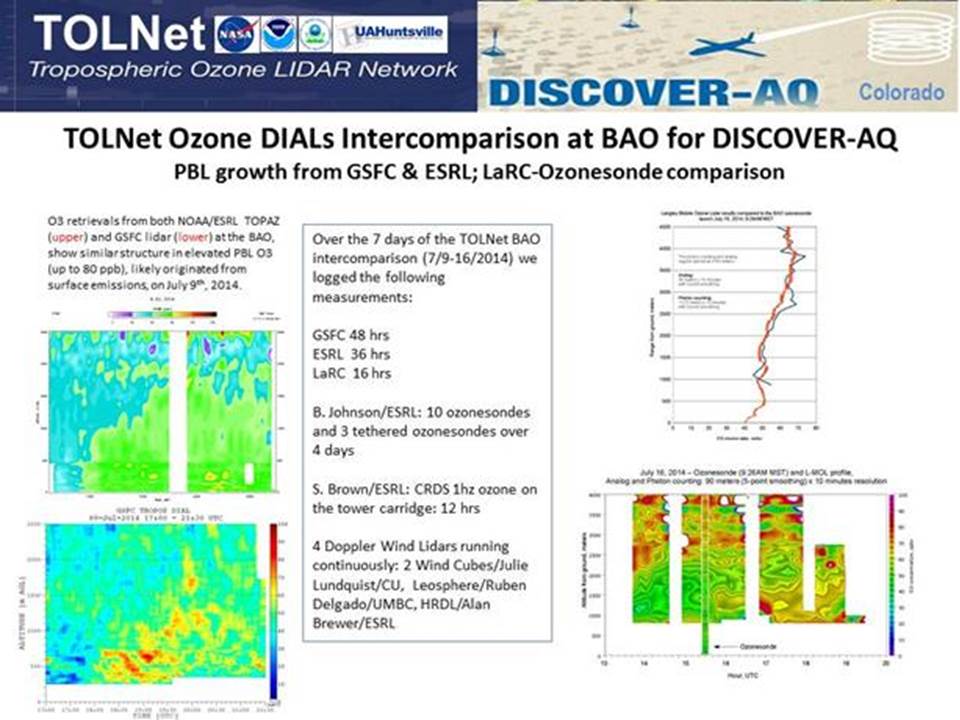
We investigate the diurnal variation of PBL ozone at the Boulder Atmospheric Observatory (BAO) in July 2014 using multiple observations, including three ozone DIALs, several wind Doppler lidars, free-launched and tethered ozonesondes, and in-situ measurements on the BAO tower. Three mobile lidars from the Tropospheric Ozone Lidar NETwork (TOLNET) provide high spatial and temporal ozone profiles from near surface to the top of the troposphere. The combination of multiple observations will provide detailed structure of the diurnal variation of ozone. This ozone information will help the satellite and modeling communities to study the character of lower tropospheric ozone for the improvements of satellite retrieval and air-quality models. In addition, a Large-Eddy Simulation model will calculate ozone in the mixed layer to explain the processes responsible for the observations.