Attenuation Characteristics of Strong Ground Motions during the Mw 6.1 South Napa Earthquake
Hongjun Si1, Kazuki Koketsu2, Hiroe Miyake3 and Rami Ibrahim1, (1)University of Tokyo, Bunkyo-ku, Japan, (2)University of Tokyo, Earthquake Research Institute, Tokyo, Japan, (3)Earthquake Research Institute, University of Tokyo, Tokyo, Japan
Abstract:
<span">
The 2014 South Napa earthquake (Mw 6.1, GCMT) occurred near the American Canyon, California, at 3:20 on 24 August 2014. The earthquake is the largest damaging earthquakes in the area since the 1989 Mw 6.9 Loma Prieta earthquake. <span">A large number of strong ground motions were recorded during this earthquake. We discuss the attenuation characteristics of the strong ground motions of the earthquake.<span">The data used in this study are PGAs compiled by the Center for Engineering Strong Motion Data (CESMD), while the records derived at the stations located in a building were excluded. PGA is defined as the larger one among the PGAs of two horizontal components. We use a source model derived based on the waveform inversion by Dreger (2014). Based on the source model, we calculated the fault distance (FD) and the median distance (MED) which defined as the closest distance from a station to the middle line of the fault plane.
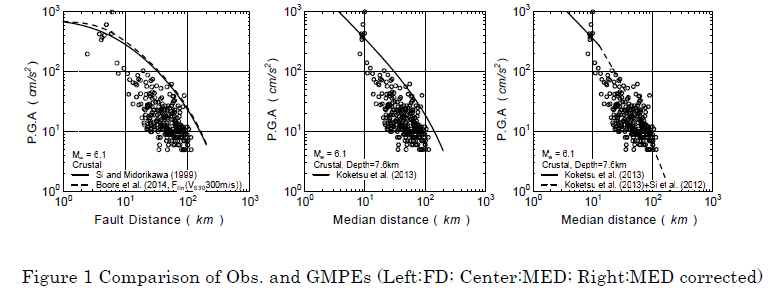
We compared the observed PGAs with the GMPEs developed both in US (Boore et al., 2014) and Japan (Si and Midorikawa, 1999; Koketsu et al., 2013), as shown in Figure 1 (left, and center). The predictions by the GMPEs are generally consistent with the observations in near-field area, but overestimated at stations farther than about 10 km in fault distance. The reasons of the overestimates are assumed as follows: (1) the backward propagation effects since many far stations are located in bay area, (2) the energy loss when the seismic waves pass through the sharp discontinuities in the shear wave velocity structure. The second reason are taken into account for the case using MED based on the methods used in Si et al. (2012, 15WCEE). The corrected predictions are significantly improved (Figure 1, right).