Virtual California, ETAS, and OpenHazards web services: Responding to earthquakes in the age of Big Data
Mark R. Yoder1, Kasey Schultz1, John B Rundle2, Margaret T Glasscoe3 and Andrea Donnellan4, (1)University of California Davis, Davis, CA, United States, (2)University of California Davis, Department of Earth and Planetary Sciences, Davis, CA, United States, (3)University of Alabama in Huntsville, Huntsville, United States, (4)Jet Propulsion Laboratory, California Institute of Technology, Pasadena, United States
Abstract:
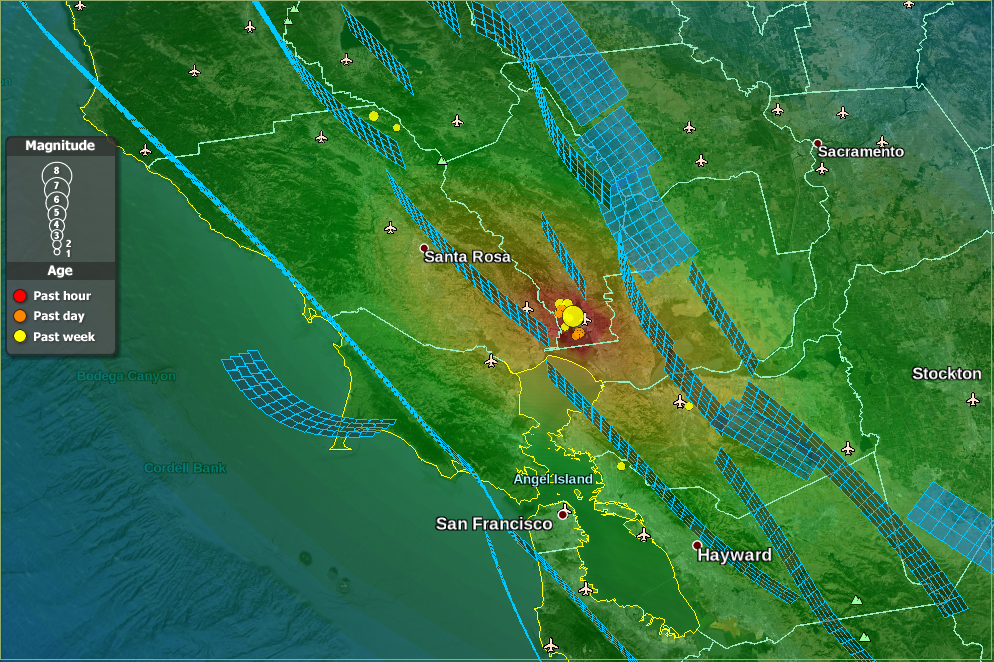
The response to the 2014 m=6 Napa earthquake showcased data driven services and technologies that aided first responders and decision makers to quickly assess damage, estimate aftershock hazard, and efficiently allocate resources where where they were most needed. These tools have been developed from fundamental research as part of a broad collaboration -- facilitated in no small party by the California Earthquake Clearinghouse, between researchers, policy makers, and executive decision makers and practiced and honed during numerous disaster response exercises over the past several years. On 24 August 2014, and the weeks following the m=6 Napa event, it became evident that these technologies will play an important role in the response to natural (and other) disasters in the 21st century.
Given the continued rapid growth of computational capabilities, remote sensing technologies, and data gathering capacities -- including by unpiloted aerial vehicles (UAVs), it is reasonable to expect that both the volume and variety of data available during a response scenario will grow significantly in the decades to come. Inevitably, modern Data Science will be critical to effective disaster response in the 21st century. In this work, we discuss the roles that earthquake simulators, statistical seismicity models, and remote sensing technologies played in the the 2014 Napa earthquake response. We further discuss “Big Data” technologies and data models that facilitate the transformation of raw data into disseminable information and actionable products, and we outline a framework for the next generation of disaster response data infrastructure.