Wide Field Electromagnetic Method for Marine Shale Gas Exploration in Southern China
Abstract:
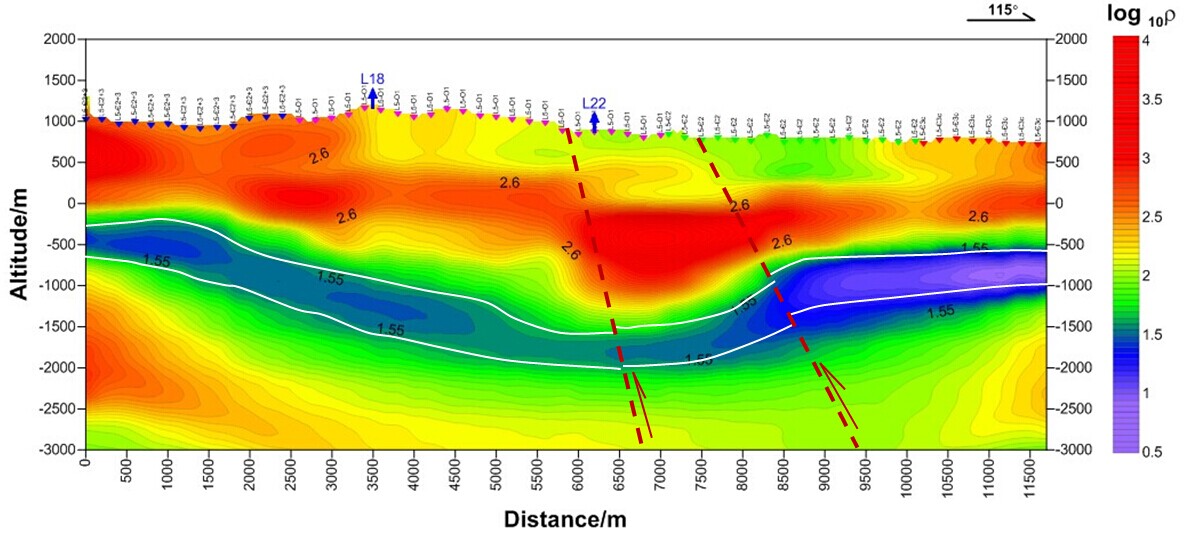
We used WFEM for shale gas exploration in South China and selected the Bayan syncline in Huayuan block as a pilot area for data acquisition and interpretation. We deployed 7 survey lines, with the total covered area of about 150km2. The experiments show that, WFEM is an effective geophysical tool for marine shale gas exploration in China. Using this technology, we identified underground structures and faults in the area and find out the distribution, depth, thickness of target strata. The inversion results clearly define the resistivity and thickness of target shale stratum and surrounding rocks. Taking Line 5 for example (Fig.1) , the inverted WFEM section shows that the overburden in the survey area has a resistivity of 1000-2000ohm-m, a thickness of 1000-3000m, the target layer has a resistivity of 10-100ohm-m, a thickness of 300-500m, while the underlying half-space has a resistivity over 100ohm-m. Besides, from the resistivity distribution, we can also identify two faults at locations respectively between 6500m-7500m and 8000m-9000m in the profile.
By further analyzing the correlation between induced polarization rate, resistivity and TOC of shale formation, we found that both the resistivity and the polarization rate are correlated positively with the TOC, so that we can delineate favorable zones for shale gas reservoirs. By combining with borehole data, we determined the thresholds for resistivity and polarization rate and chose the most favorable areas (sweet spots) for shale gas development.