MLT Dynamics Related to Major Sudden Stratospheric Warming Events
Abstract:
Observational and modeling capabilities above the upper stratosphere reveal that major SSWs are invariably coupled to the mesosphere and lower thermosphere (MLT). With the onset of rapid polar warming and wind reversal, this upward reach of major SSWs is manifested in the elevation of the stratopause, cooling of the polar mesosphere, and enhanced descent of trace species into the stratosphere from their MLT reservoirs. Thus, examining the MLT dynamics associated with major SSWs may improve our understanding of SSW evolution and its eventual impact on surface climate.
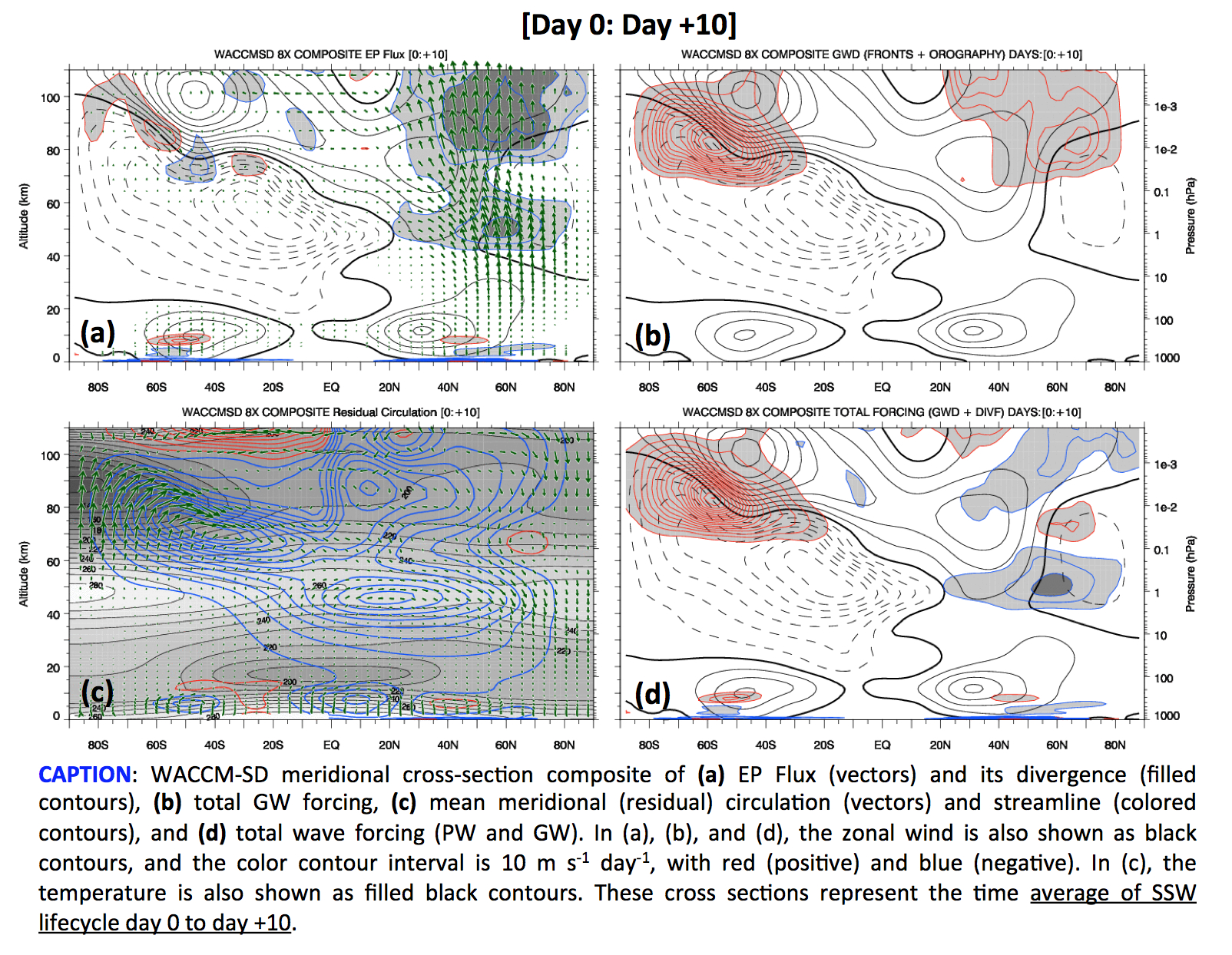
Here, we use 3-hourly output from the NCAR Whole Atmosphere Community Climate Model with “Specified Dynamics”, in which the simulation is constrained by meteorological re-analyses below 1 hPa. Model results are complemented by MLT meteor radar measurements and satellite observations from NASA SABER and MLS. To elucidate the associated MLT dynamics, case studies and composite of major SSW events with elevated stratopause occurring between 1994-2013 are carried out.
The interplay between gravity wave (GW) and planetary wave (PW) forcing is important in the initiation of major SSW and the vortex recovery. Characteristics of both GWs and PWs evolve with the SSW lifecycle. MLT GW zonal momentum forcing switches from westward to eastward with SSW onset and back to westward at the formation of the elevated stratopause. Enhancement of PWs in the MLT occurs shorty after SSW onset and is associated either with strong upward propagating PWs (of tropospheric origin) that had been ducted into the MLT or generated in situ by flow instability induced by the altered circulation. The combined GW and PW forcings drive the strong wind and temperature anomalies linking the polar stratosphere with the MLT.