Uncertainty in Measured Data and Model Predictions: Essential Components for Mobilizing Environmental Data and Modeling
Abstract:
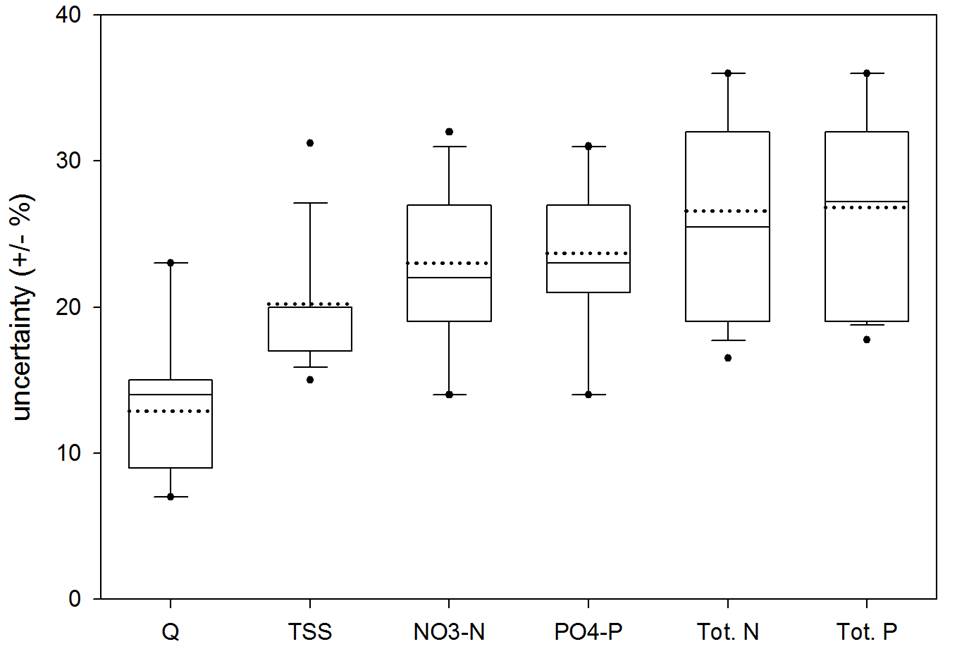
In response we produced an uncertainty estimation framework and the first cumulative uncertainty estimates for measured water quality data (Harmel et al., 2006). From that framework, DUET-H/WQ was developed (Harmel et al., 2009). Application to several real-world data sets indicated that substantial uncertainty can be contributed by each data collection procedural category and that uncertainties typically occur in order discharge < sediment < dissolved N and P < total N and P.
Similarly, modelers address certain aspects of model uncertainty but ignore others, such as the impact of uncertainty in discharge and water quality data. Thus, we developed methods to incorporate prediction uncertainty as well as calibration/validation data uncertainty into model goodness-of-fit evaluation (Harmel and Smith, 2007; Harmel et al., 2010). These enhance model evaluation by: appropriately sharing burden with “data providers”; facilitating more realistic model performance evaluation; better determining model deficiencies (e.g., where simulations do not fall within the uncertainty range of measured data); and more accurately communicating model performance.