Variability of the SPCZ as detected by a statistical model using thirty years of 3-hrly geostationary IR images in Nov-Apr
Abstract:
Results show two distinct parts to the SPCZ, the western tropical part and the eastern subtropical part. For certain time periods, the two parts do not connect. They are oriented quite differently, such that the subtropical part has a steeper meridional slope. The SPCZ is present 50-70% of the time in the tropics from Jan–Mar and is usually anchored to the warm SST distribution of the equatorial west Pacific. The subtropical part of the SPCZ does not have the same sensitivity to the underlying SST distribution and is present more often in Nov–Dec and April than in Jan-Mar when the SST is highest. Diurnal variability in cloud top height within the SPCZ also highlights the two distinct parts of the SPCZ. The tropical part has a diurnal cycle of cloudiness typical of that for the boreal summer ITCZ in the east Pacific whereas that is not the case for the subtropical part.
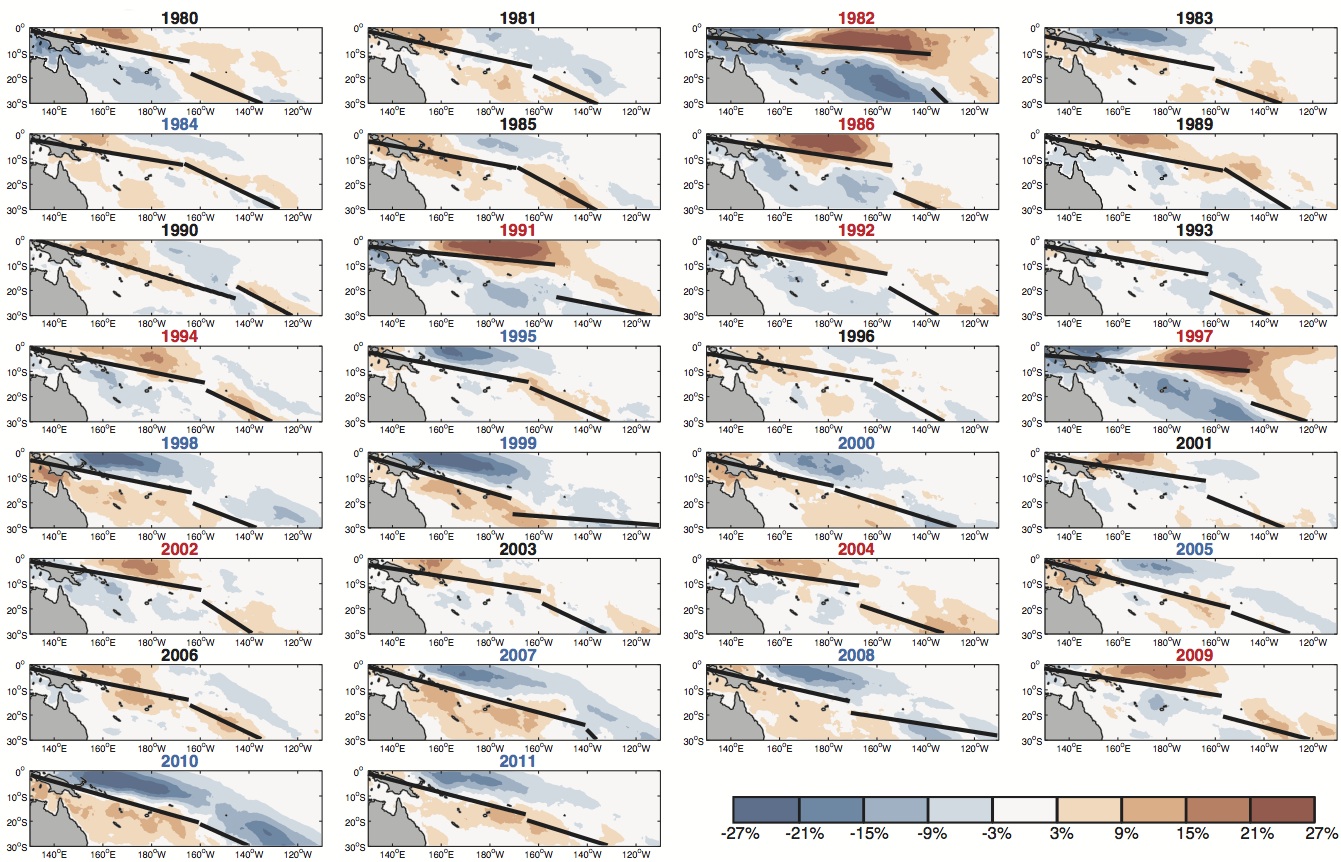
Interannual variability in SPCZ location is strongly associated with ENSO, however no change in overall SPCZ area is associated with ENSO. On the intraseasonal timescale, the MJO has a strong and direct signature in SPCZ location.
Panels in the figure below show composites of SPCZ labels, in units of fraction of time present, during each season after the seasonal cycle has been removed. Red (blue) shading indicates areas where the SPCZ is more (less) frequently present in each season compared to the mean. Bold black lines show the location of the main axis of the mean SPCZ for each season. Panel labels are color coded to indicate ENSO mode: red : El Nino, blue : La Ni–a, and black : ENSO neutral.