Paleohydrological Information from Profiles in Pore Water of Holocene Low-Permeability Cores and Groundwater Flow Simulation, Lake Kasumigaura, Japan
Abstract:
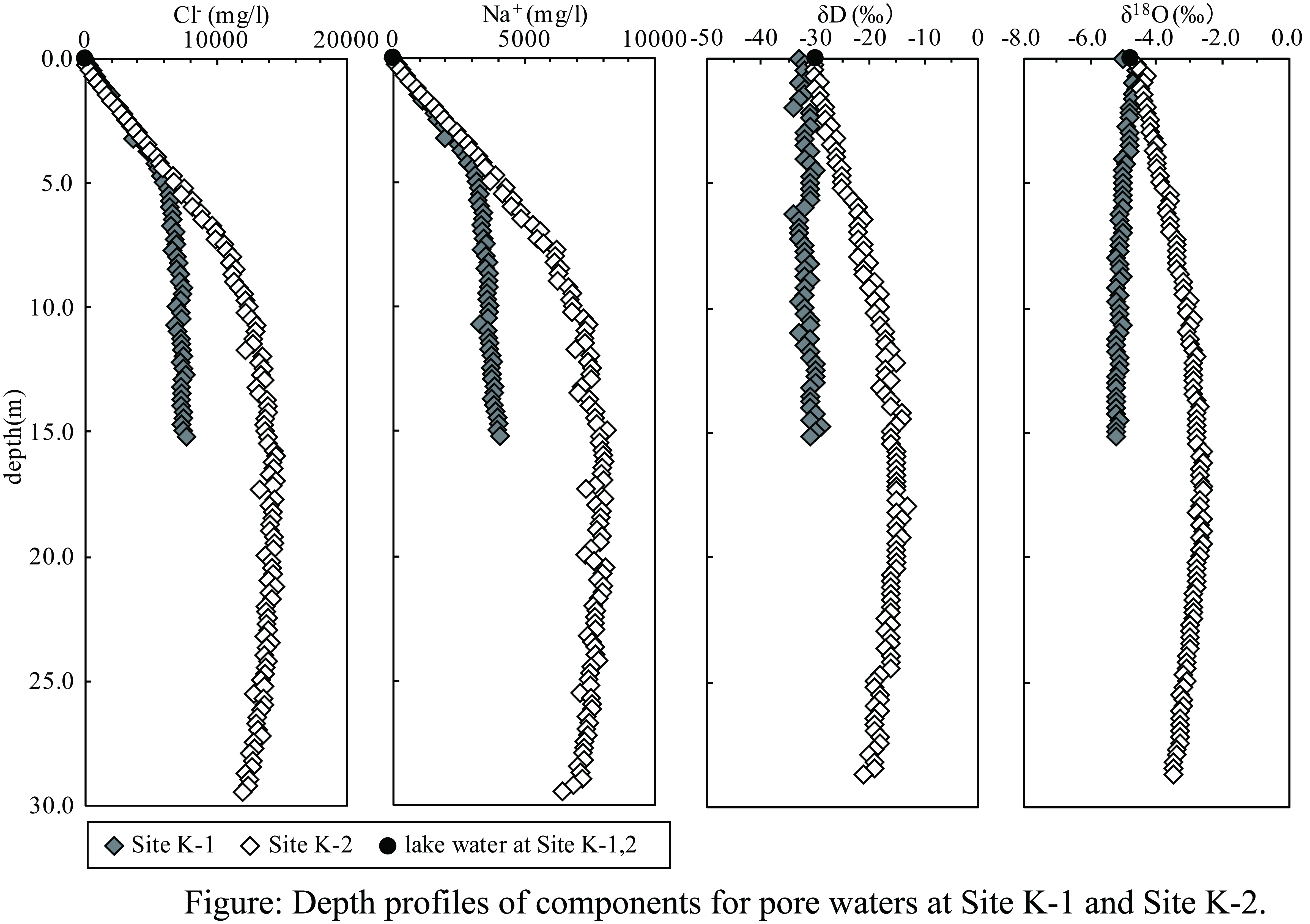
Therefore, in this study, cores were drilled into Holocene clay and silt deposits (Site K-1 and Site K-2) in the Lake Kasumigaurain Japan, where the depositional rate 10,000 years ago was rapid and it has been affected strongly by sea level changes including transgression and regression. By using the obtained core samples and extracted pore water from the cores, paleohydrologic information was investigated, and it was tried to understand hydrologic environments at the study area during a Holocene. In addition, groundwater flow and solute transport simulation were conducted to reproduce profiles of pore water.
Results of investigation show that the profiles of pore water contents reflect sea level change and the difference in hydrological environment at that time at each site. The content of the paleo-brackish water in the culmination of transgression was about 14,000 mg/l in Cl-, -13.0‰ in δD and -2.6‰ in δ18O. It is allowed better understanding paleohydrological information by studying not only inorganic chemistry contents and stable isotopes of pore water and also the diatom fossils and groundwater flow and solute transport simulation. We will characterize the paleohydrological information of the study area acquired by those investigations and analysis.