The Evolution of Methane Vents That Pierce the Hydrate Stability Zone in the World's Oceans
The Evolution of Methane Vents That Pierce the Hydrate Stability Zone in the World's Oceans
Abstract:
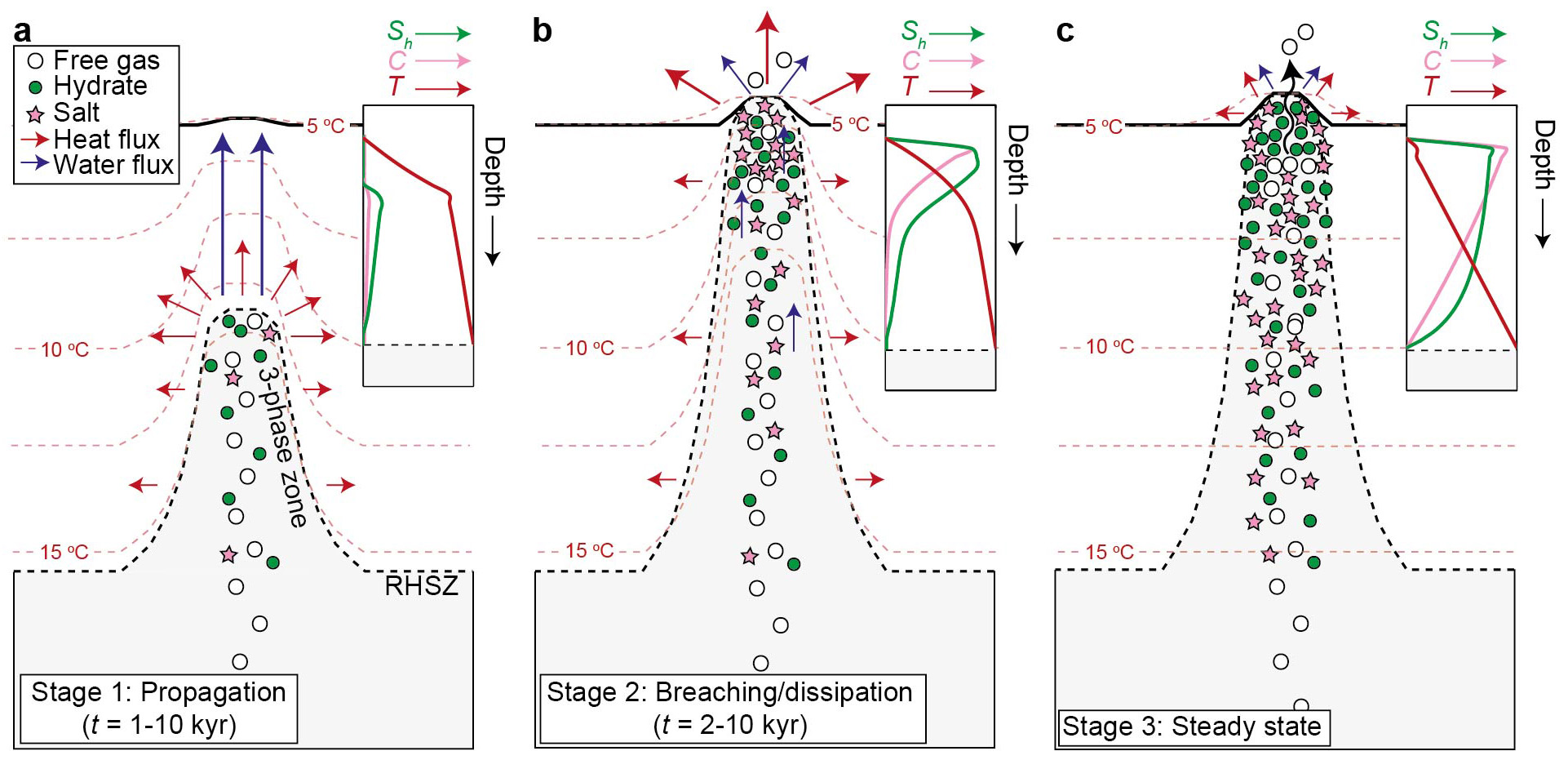
We present a one-dimensional model that couples the thermodynamics of hydrate solidification with multiphase flow to illuminate how gas vents pierce the hydrate stability zone in the world's oceans. During the propagation phase, a free-gas/hydrate reaction front propagates toward the seafloor, elevating salinity and temperature to three-phase (gas, liquid, and hydrate) equilibrium. After the reaction front breaches the seafloor, the temperature gradient in the gas chimney dissipates to background values, and salinity increases to maintain three-phase equilibrium. Ultimately, a steady state is reached in which hydrate formation occurs just below the seabed at a rate necessary to replace salt loss. We show that at the Ursa vent in the Gulf of Mexico, the observed salinity and temperature gradients can be simulated as a steady-state system with an upward flow of water equal to 9.5 mm yr−1 and a gas flux no less than 1.3 kg m−2 yr−1. Many of the world's gas vents may record this steady-state behavior, which is characterized by elevated temperatures and high salinities near the seafloor.