Timinig of Volcanism and initiation of rifting in Omo-Turkana Depression southwestern Ethiopia: Evidence from Paleomagnetism
Timinig of Volcanism and initiation of rifting in Omo-Turkana Depression southwestern Ethiopia: Evidence from Paleomagnetism
Abstract ID#: 33165
English Abstract:
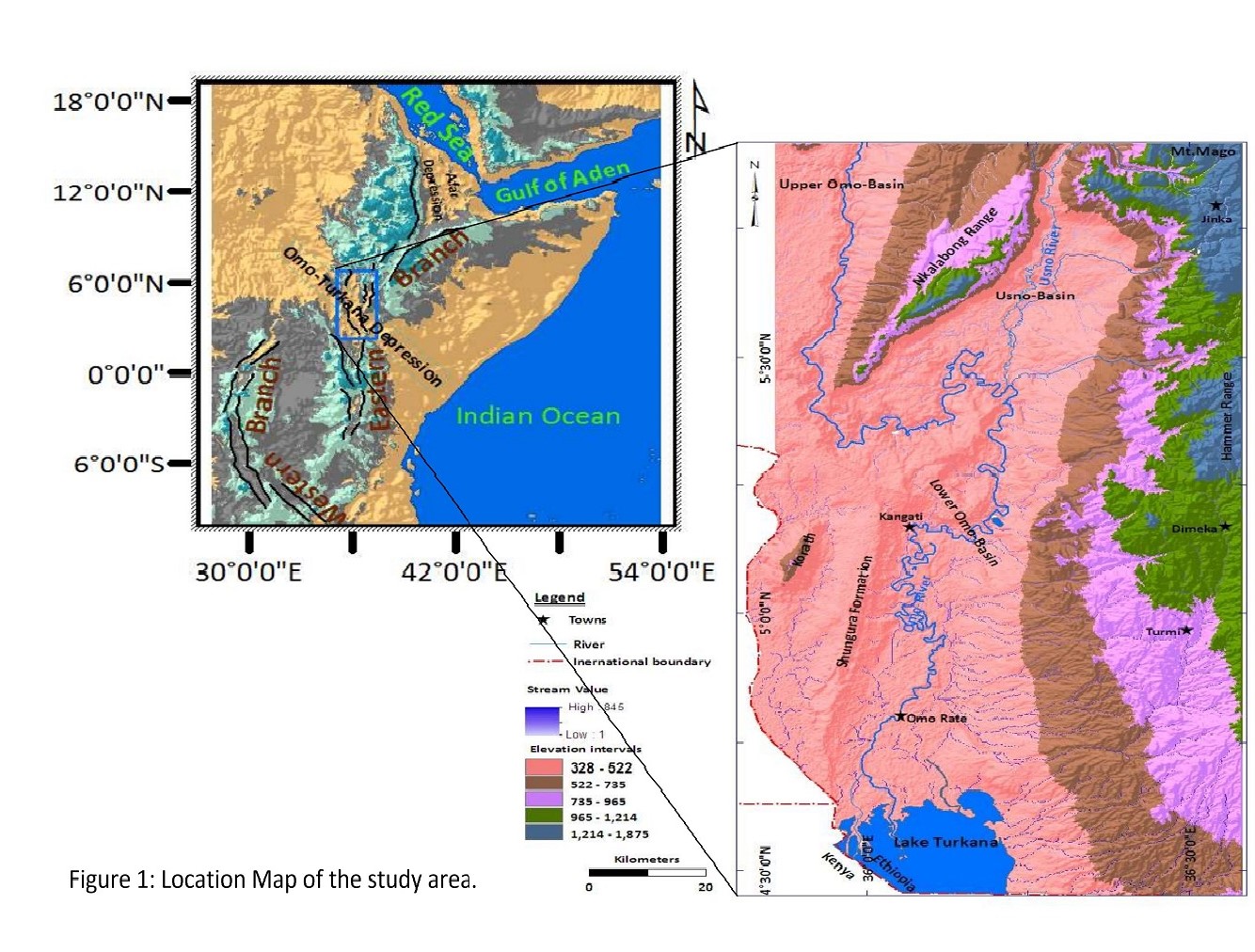
This Paleomagnetic study was carried out on Gombe Group basalts from the lower Omo Valley in southwestern Ethiopia. The objective of the study is to narrow a wide ranged previous geochronological data about timing of volcanism and initiation of rifting in the area. 80 oriented core samples were taken from nine sites. Pilot specimens were subjected to alternating field (AF), thermal demagnetization (TH) and acquisition experiments. The Natural Remnant Magnetization (NRM) direction comprises two vector components in most samples. The first component of magnetization was easily erased at 5 to 25mT AF and 120°C to 250°C TH demagnetization. A step wise increasing application of magnetic field to selected specimens revealed a saturation magnetization at about 300°C. The magnetization curve results from the acquisition experiment together with TH demagnetization of the same specimens and AF demagnetization results indicates that titanomagnetite is the dominant magnetic carrier. About 50% of magnetization is removed between Temperature ranges of 2500C and 4300C suggesting that pseudo single domains as a primary carrier of magnetic remanence. From total sites, six sites show reversed polarity and two sites show normal polarity. The normal and reversed polarities are antipodal to one another. The overall mean direction for reversed polarity is (DS=186.1, IS=-1.9,KS=38.8, α95=10.9) where as the remaining two sites with normal polarity yield (DS=348.4, IS=4.6, K=378.9, α95=12.9).By using the available upper age control of Moiti tuff and Naibar tuff which have never been noted to be intruded by the Gombe Group basalts; Gombe basalts are correlable with the late Gilbert Chron of Cande and Kent (1995). Comparison of this result with the petrographically and geochemically similar basalts (Haileab et al., 2004) in northern Kenya reflects the same polarity. Paleomagnetic data presented in this paper and previous age data results indicates, Gombe Group basalts in southwestern Ethiopia and Northern Kenya erupted during a short period geological time between 4.18Ma and 4.02Ma.Recent paleomagnetic study (Kidane, 2014) of sediments from the base of the rift is also similar with Gombe Group. This suggests that the present architecture of the basin might have been attained soon after the emplacement of the Gombe Group basalt.