
Gold Mineralization and Genetic Evaluation in the North Khentei Gold Belt, Central Northern Mongolia
Gold Mineralization and Genetic Evaluation in the North Khentei Gold Belt, Central Northern Mongolia
Previously Published Material: Khishgee, C., Akasaka, M., Ohira, H. and Sereenen, J. (2014) Gold mineralization of the Gatsuurt deposit in the North Khentei gold belt, central northern Mongolia. Resource Geology, 64, 1-16.
Abstract ID#: 33450
English Abstract:
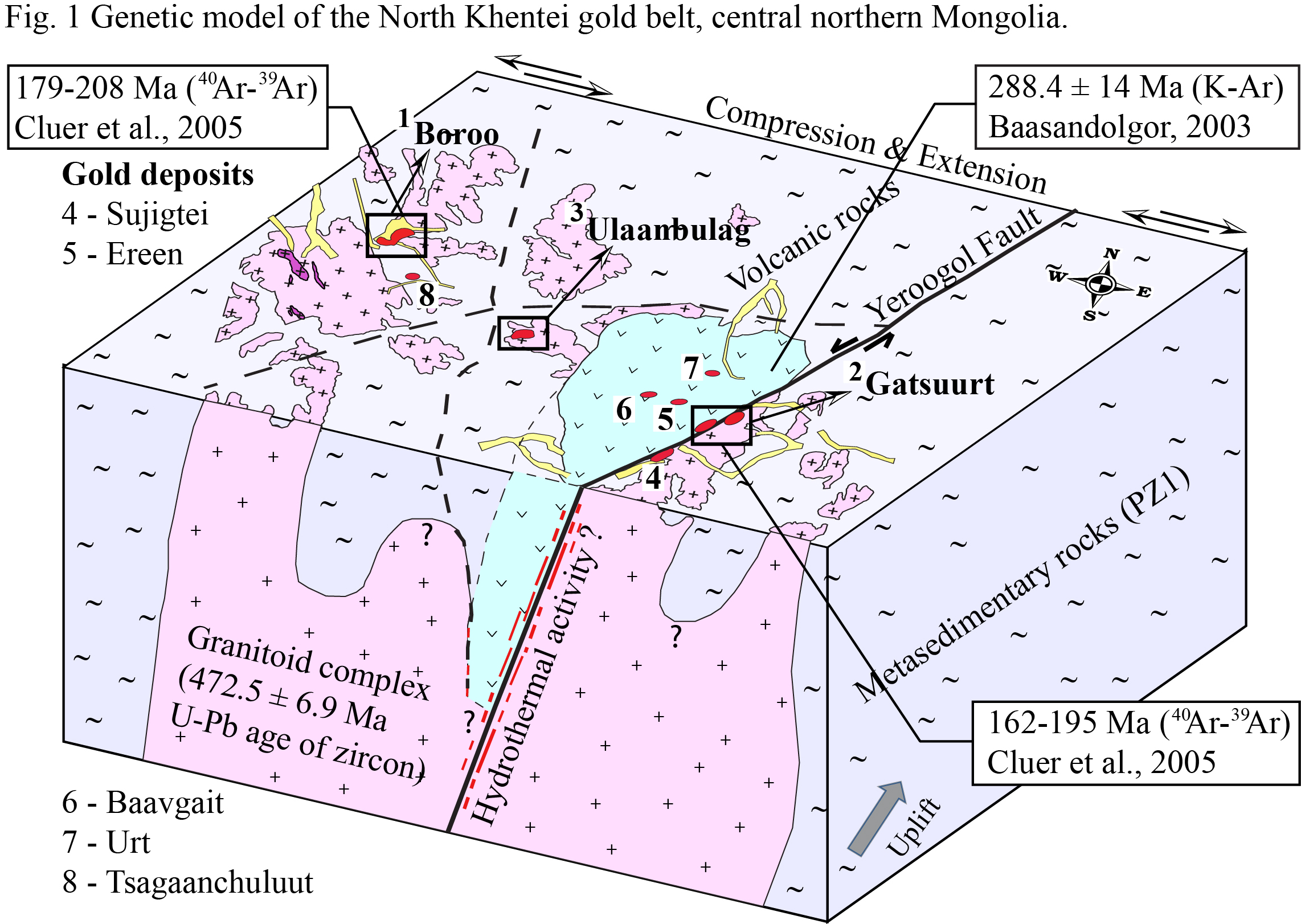
Gold mineralization and crystallization sequences of ore-forming minerals in representative deposits of the North Khentei gold belt of Mongolia were investigated to characterize the ore genesis. The Au mineralization occurs as two ore types: I) disseminated and stockwork ores; and II) auriferous quartz-veins. Type-I mineralization in the 1Boroo, 2Gatsuurt and 3Ulaanbulag deposits is composed of four distinct stages: (i) 1,2,3pyrite-I + 1,2,3arsenopyrite-I, (ii) 1,2,3pyrite-II + 1,2,3arsenopyrite-II, (iii) 1,2,3sphalerite + 1,2,3galena + 1,2,3chalcopyrite + 1,2tetrahedrite + 1,2bournonite + 1,2boulangerite + 2jamesonite + 2scheelite + 1alloclasite + 1native gold and (iv) 1,2,3native gold. In Type-II mineralization, five, four and four crystallization stages are also recognized in these deposits, respectively: (i) 1,2,3pyrite-I + 1,3arsenopyrite, (ii) 1,2,3pyrite-II + 1,2,3arsenopyrite + 2galena + 2tetrahedrite-tennantite, + 2sphalerite + 2chalcopyrite + 2,3bournonite, (iii) 1,3sphalerite + 1,3galena + 1,3chalcopyrite + 2geocronite + 2geerite + 2native gold, (iv) 1tetrahedrite-tennantite + 1bournonite + 1geerite + 1,2,3native gold, and (v) 1electrum. Both ore types are associated with sericitic and siliceous alteration. At Boroo and Gatsuurt both ore types contain coexisting CO2-rich and aqueous fluid inclusions. The inclusions in the Type-I ores homogenized between 254–362ºC, whereas Boroo Type-II ore inclusions homogenized between 237–305ºC. Fluid salinities in both ore types range from 3–6 wt% (NaCl equiv.). The U-Pb age of zircons from Boroo host granites of 472.5 ± 6.9 Ma is much older than previously defined alteration minerals ages (Fig.1). The results indicate that these gold deposits can be classified as contiguous orogenic-type gold mineralization that developed in two stages. Type-I ores are early stage, formed by hydrothermal metasomatic alteration, and Type-II ores are later stage, deposited due to rapidly cooling temperature of the hydrothermal fluids.
Back to: Mineral Deposits and Ore Minerals II