Computing dynamic titania activities through metamorphic evolution and implications on Ti-in-quartz thermobarometry
Computing dynamic titania activities through metamorphic evolution and implications on Ti-in-quartz thermobarometry
Previously Published Material: A manuscript on this work was submitted to Contributions to Mineralogy and Petrology, with a revised draft currently being processed by the editorial board.
Abstract ID#: 33474
English Abstract:
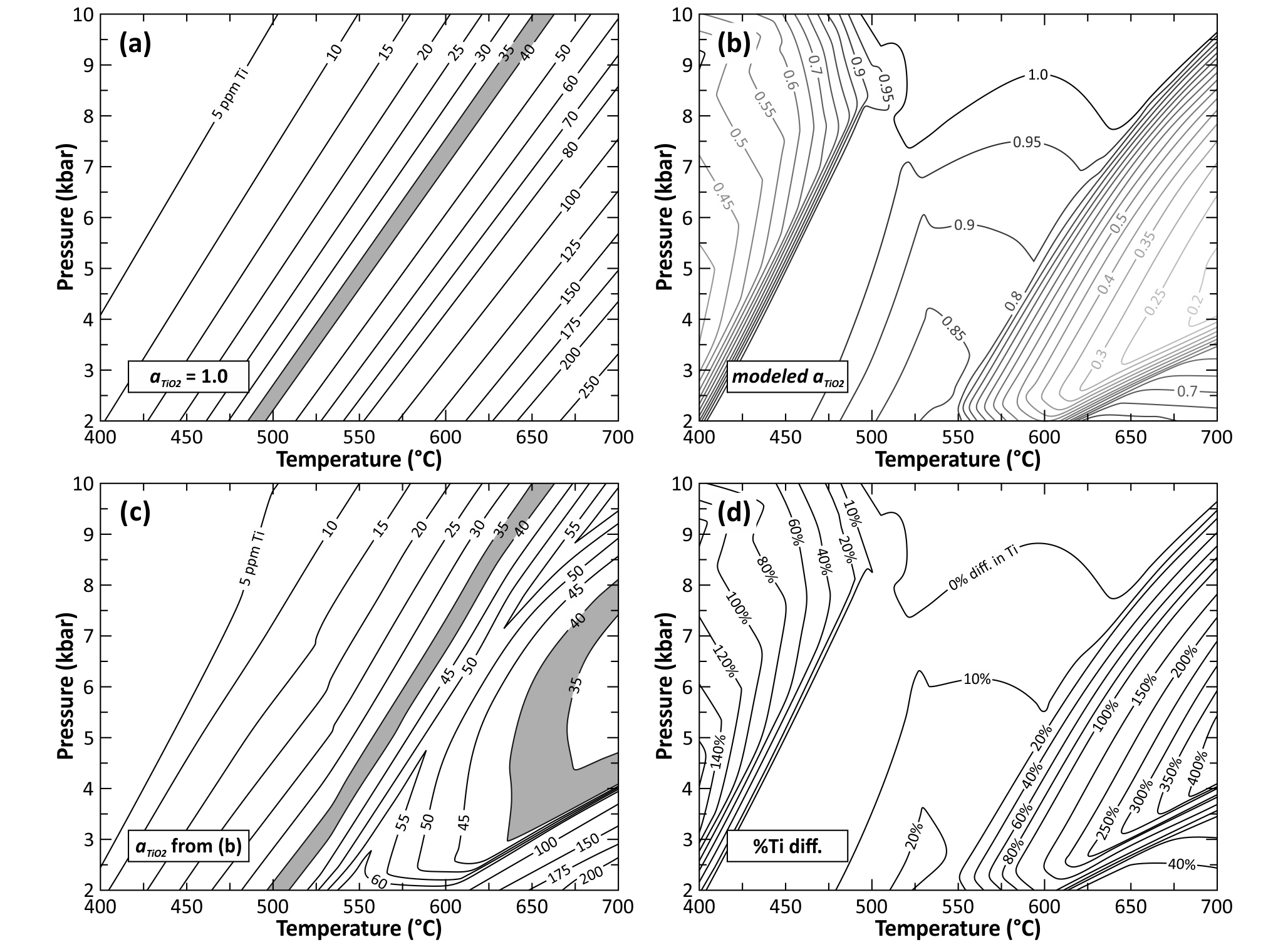
Meaningful metamorphic P-T estimation is made difficult due to susceptibility of minerals to chemical modification during retrogression and complex cation partitioning that occurs in some crystal systems. The simple exchange of Ti for Si in quartz and slow diffusion of Ti during retrogression makes Ti-in-quartz a potentially powerful thermobarometer. Calculation of temperature is dependent on estimating titania activity at the time of quartz growth. In metapelites this may be reasonably estimated if ilmenite or rutile is stable. However, due to participation of quartz in solution-transfer processes and metamorphic reactions throughout the P-T history, calculating temperatures while only considering peak paragenesis may be erroneous. Here we calculate TiO2 chemical potentials for known bulk rock compositions relative to that of a rutile-containing system (i.e., a standard state system) through the thermodynamic calculation package Perple_X and pseudosection generation. When projected in P-T space, a titania activity map is generated which allows for assessment of Ti solubility in quartz under various geologic conditions. Calculated activities are used to adjust the Ti-isopleth projection in P-T space. For an average sub-aluminous pelite composition, results are in good agreement with previous studies that found ilmenite-bearing assemblages buffer high TiO2 activities (nearly 1.0), with lower activities for titanite-bearing assemblages (≥0.5). At high temperatures, significant deviation from an assumed pelite titania activity of 1.0 exists; here, assuming a dynamic activity results in Ti concentrations in quartz up to 400% different from assuming a standard state. This is due, in part, to sequestering Ti in biotite and destabilization of Ti-oxides at higher T. These large Ti discrepancies result in large temperature uncertainties. Therefore, our modeling approach may provide a method to better refine titania activities for quartz growth throughout the P-T history.