New Results of Earthquake Relocation in Charlevoix Seismic Zone, Eastern Canada and Implications for Regional Geological Structure
Abstract ID#: 33670
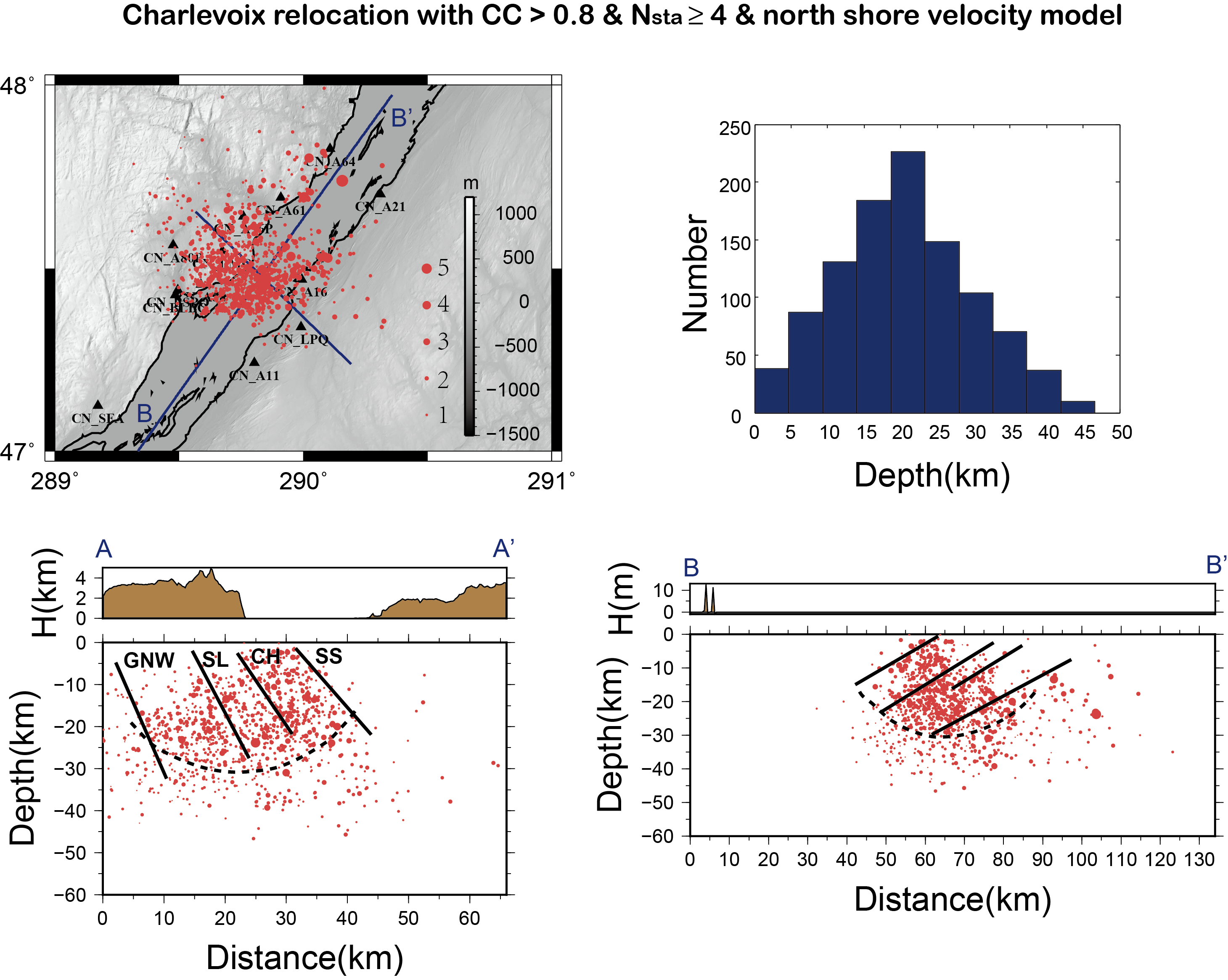
In this study, we studied 1442 earthquakes that occurred in the CSZ area during January 1988 and October 2010, using the Double-Difference Hypocenter Locations (HYPODD, Waldhauser & Ellsworth (2000)) method. Broadband waveforms from 7 permanent CNSN stations are used in the relocation. We manually picked 11,525 P wave arrivals out of 29,737 recordings, with the reference of automatically picked P phases using the maximum kurtosis and κ-statistics criteria (C. D. Saragiotis et al., 2004). We used a layered CSZ velocity model from Lamontagne (1999). In total 1035 (71.8%) events have been relocated, by setting the cross-correlation coefficient (CC) to be greater than 0.8 at 4 or more stations.
The relocated earthquake hypocenters depicts the impact crater. Cross-section profiles also show a “bowl” shape envelope at the bottom of the seismicity. Events are more aggregated under SLR than under the north shore area, indicating that rifting faults beneath the SLR are probably weaker structures. The relocated earthquakes also define a series of SE steeply dipping faults, which are consistent with the surface traces of the Gouffre NW fault, the St-Laurent fault, Charlevoix fault and South shore fault. Finally, a series of SW low-angle dipping faults under SLR also agree with local compressive stress orientation implied by previous CSZ focal mechanism solutions (Zoback & Zoback, 1991).