ULTRAMAFIC HOSTED NI-CU-PGE DEPOSITS IN THE SEILAND IGNEOUS PROVINCE (SIP) NORWAY: ORE-FORMING PROCESSES AT THE ROOTS OF A GIANT MAGMATIC CONDUIT SYSTEM
Abstract ID#: 34106
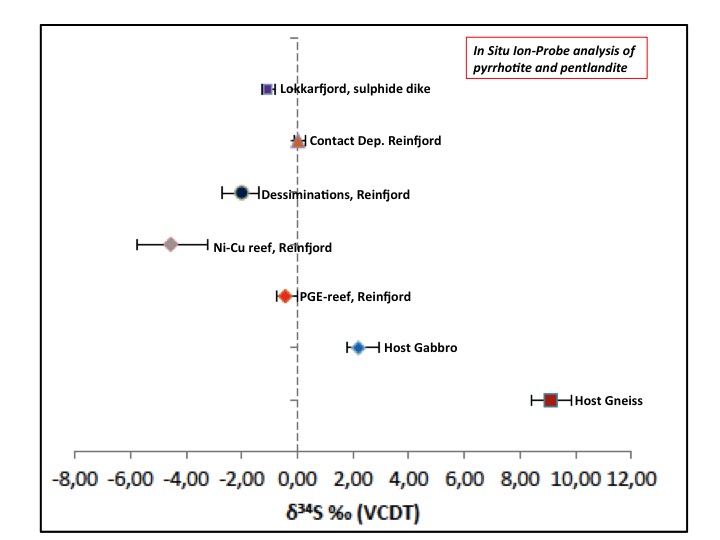
The chondrite normalised PGE spectrum shows a trough pattern with positive Os, Pt, Pd and Au anomalies for both deposits and a positive Rh anomaly for Lokkarfjord. In-situ, ion-probe, S-isotope analysis yielded juvenile values for all sulphide deposits in both Reinfjord and Lokkarfjord and the country rock gabbros. The PGE-reef yielded average δ34S value of -0.40, the Cu-Ni reef, -4.56, the contact deposits +0.02. Lokkarfjord gave -1.9. Gabbro-hosted barren sulphides gave +2.19 and barren sulphides in country rock gneisses yielded +9.09.
Accordingly, sulphur is not assimilated from country-rock gneiss or gabbro. The PGE-reef sulphur is distinctively different from the Cu-Ni reef only 20 m’s higher up. The conspicuous trough shaped PGE-pattern with positive Os but negative Ir and Ru is a rare signature for PGE-deposits. Also conspicuous we note the great thicknesses of the reefs, a clear separation of a PGE-Ni and a Ni-Cu reef and strongly contrasting S-isotope signatures over only 20 metres of cumulates.
Our studies imply that the ultra-mafic complexes comprises volcanic conduits of a giant magmatic system accomodating deep-seated plume related melts that were at or close to sulphide-saturation at emplacement. Ore-genesis is a complex interplay of multiple replenishment episodes, interstitial melt migration and dissolution-reprecipitation of silicates as well sulphide phases.