Partial melting, orogeny and crustal differentiation
Partial melting, orogeny and crustal differentiation
French Title: Fusion partielle, orogénèse et différentiation crustale
Previously Published Material: The presented research is a synthesis of previously published papers (Vanderhaeghe & Teyssier, Tectonophysics, 2001; Vanderhaeghe et al., Journal of Geodynamics, 2003; Vanderhaeghe, Tectonophysics, 2009; Vanderhaeghe, Journal of Geodynamics, 2012) augmented with ongoing work.
Abstract ID#: 34107
English Abstract:
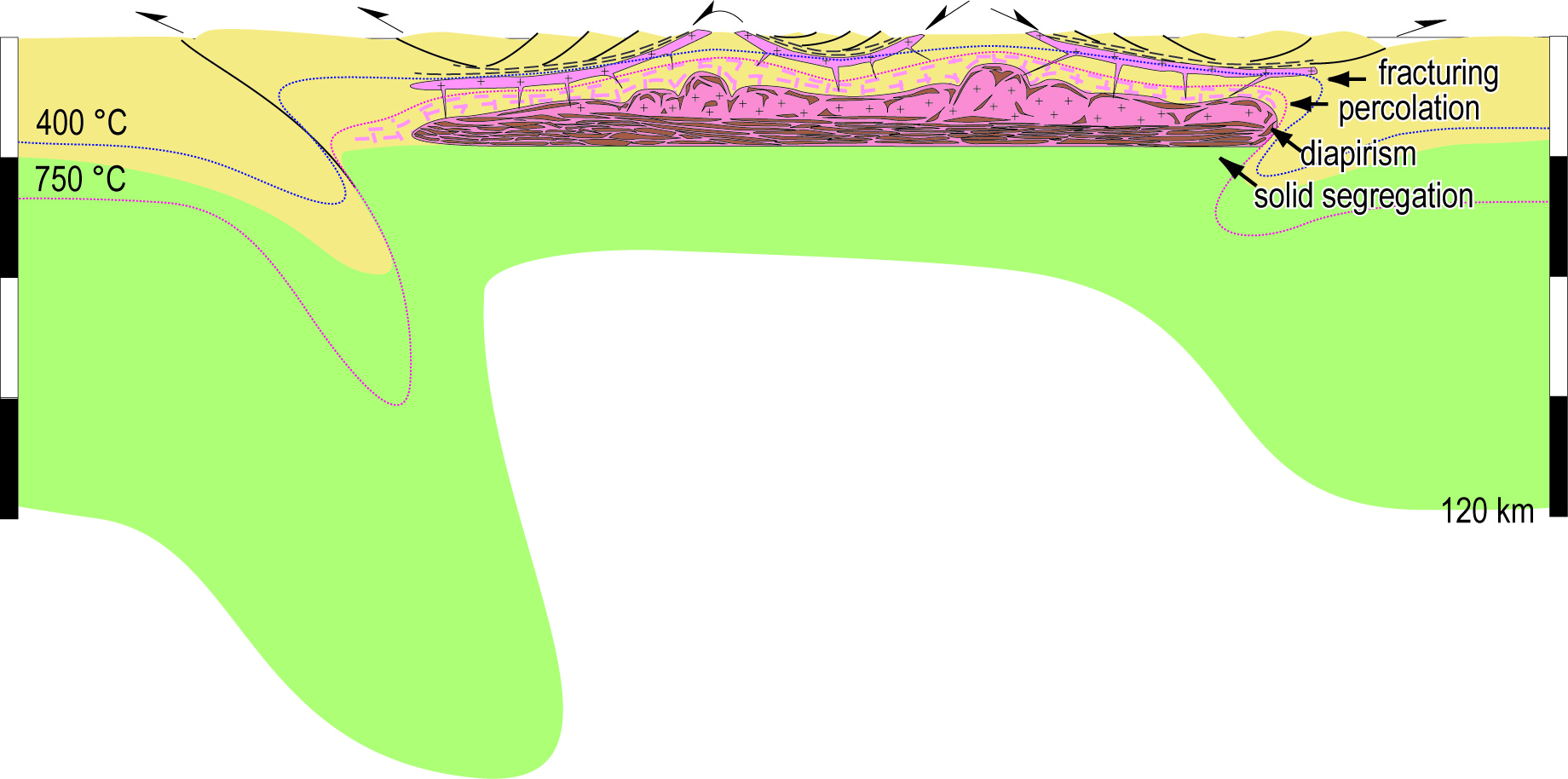
Partial melting of the crust plays a key role during orogenic evolution and leads to crustal differentiation as it impacts rheology and allows for melt/solid segregation and thus for magma transfer. These processes are controlled by (i) the dynamic balance among forces arising from plate-tectonic, gravitational potential energy, and buoyancy, (ii) the thermal balance between deformation-induced and radioactive heat production and heat advection related to subduction, orogenic deformation, and magma transfer.
The strength decrease associated with partial melting leads to strain partitioning expressed by channel flow driven either by forces related to plate tectonics and/or buoyancy (vertical extrusion) or by the gravity force associated with lateral variations of crustal thicknesses (horizontal channel flow). Structural characteristics of migmatites point to the role of deformation in melt migration, but the emplacement of laccoliths of leucogranites above migmatitic terranes attests to the efficiency of the buoyancy force. The transition from partially-molten rocks to magmas is marked by another strength decrease allowing for settling of floating/sinking solids and favoring the development of gravitational instabilities (domal flow) evidenced by domes cored by diatexites (former heterogeneous magmas) mantled by metatexites (former partially-molten rocks).
Melt/solid segregation and magma mobility during orogeny leads to the development of a crustal-scale horizontal layering. The middle crust is dominated by migmatites with domes cored by diatexites and mantled by metatexites that correspond to a partially-molten and magmatic zone, respectively. The granitic dikes and sills and the associated laccoliths of leucogranites correspond to an intrusive zone overlying the partially-molten zone. The refractory lower crust comprises residual and non-fertile material segregated and from the overlying heterogeneous magmas and partly accumulated against the Moho.