A 1 Ga Eclogite-bearing Hot Migmatitic Nappe in the Sveconorwegian Orogen – a Window into Depth beneath the Frontal Part of a Precambrian Himalayan-Tibetan-type Plateau
Previously Published Material: Möller, C., Andersson, J., Dyck, B., Antal Lundin, I. 2014: Exhumation of an eclogite terrane as a hot migmatitic nappe,Sveconorwegian orogen, in: Castelli, D., Godard, G., Hirajama, T., Medaris, G. (Eds.), High‐ and ultrahigh‐pressure metamorphism, from microscopic to orogenic scale. Lithos (Special Issue). DOI 10.1016/j.lithos.2014.12.013
Abstract ID#: 34118
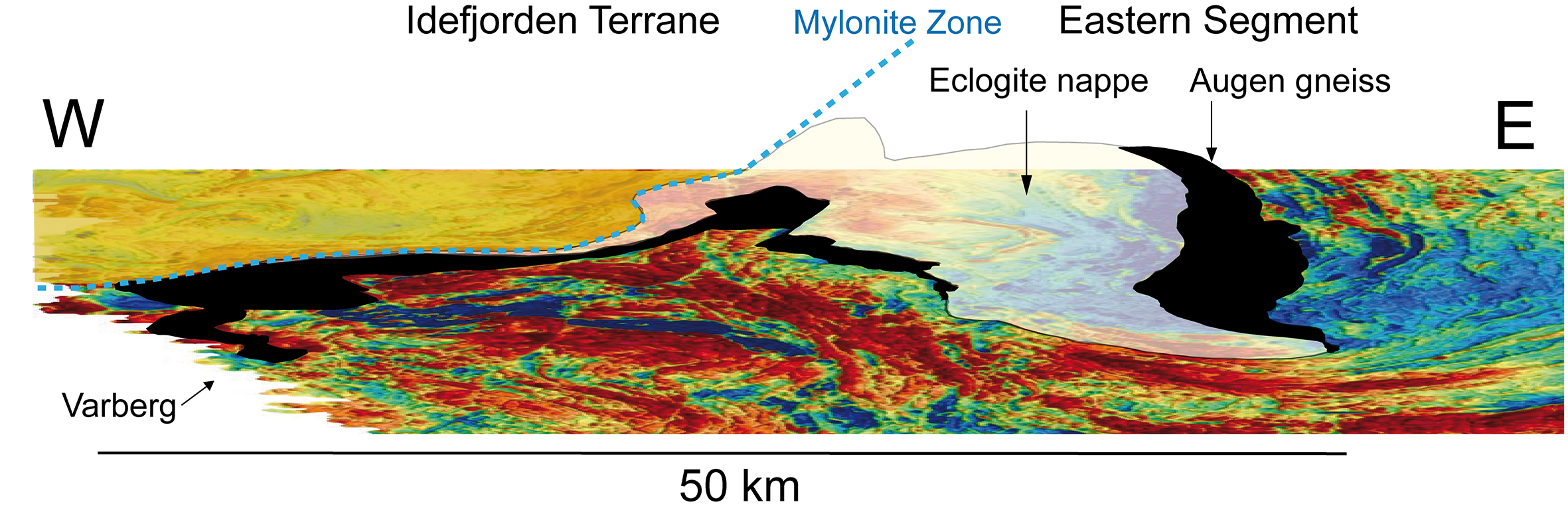
The Eastern Segment is semi-continuous with the continental foreland in the east (Baltica) but tectonically bound by a major crustal shear zone, the “Mylonite Zone”, at the contact to the Idefjorden Terrane in the west. Different lines of evidence indicate that this boundary is a deep collisional suture, where the Eastern Segment was down-thrusted “India-style” beneath the frontal part of a Himalayan-Tibetan-type plateau: 1) the eclogite-bearing nappe is located at the boundary; 2) the Eastern Segment and the Idefjorden Terrane both experienced metamorphism ≤ 0.98 Ga, but share neither pre-Sveconorwegian 1.7-1.1 Ga nor Sveconorwegian 1.05-0.99 Ga igneous and tectonic evolutions.
The eclogite-bearing nappe in the Eastern Segment demonstrates that extrusion of melt-weakened crust is a viable exhumation mechanism within hot and deep collision zones. The eclogites are structurally restricted to a regional recumbent fold in which stromatic orthogneiss with pods of amphibolitized eclogite make up the core. High-temperature mylonitic gneiss with remnants of kyanite eclogite compose a basal shear zone, <4 km wide. Heterogeneously sheared and partly migmatized augen gneiss forms a tectonostratigraphic marker in front of and beneath the nappe, and is in turn structurally enveloped by a composite sequence of orthogneisses and metabasites. The entire tectonostratigraphic pile underwent near-pervasive deformation and recrystallization under high-pressure granulite and upper-amphibolite conditions.