
Crustal shortening, pop-down tectonics, fluid channelling and ore transfers within hot lithospheres – implications for Precambrian Cratons
Crustal shortening, pop-down tectonics, fluid channelling and ore transfers within hot lithospheres – implications for Precambrian Cratons
Previously Published Material: Part of the abstract was presented in private conferences, and also at the GSA meeting in Denver in 2013. The presentation will include new data acquired since this time
Abstract ID#: 34185
English Abstract:
Field and experimental works dedicated to deformation modes of hot lithospheres in compressive regimes show major differences compared to modern orogenic belts (Gapais et al., 2014, Tectonophysics 618, 102–106). These works led to a new tectonic model marked by compression-induced downward motions of pop-downs of upper-crustals that pile up along vertical deformation zones. Downward motion of upper-crustals does not require any gravity-induced processes as potentially attached to sagduction of heavy greenstones. The first-order requirement is just a hot and weak lithosphere with a ductile lithospheric mantle (fig. 1). In such a context, pop-downs of upper crust pile up along vertical deformation zones potentially connected with the underlying ductile mantle. These zones are marked by high strains, steeply dipping foliations and steeply plunging stretching lineations. These zones are particularly favourable for circulations of fluids of various origins from surface to mantle and for long-lived fluid-rock interactions (Fig. 1).
We present field examples showing structural features arguing that pop-down tectonics may be a key for various ore concentrations in various crustal levels within ancient hot deformation belts of various ages, from Archaean to Palaeoproterozoic.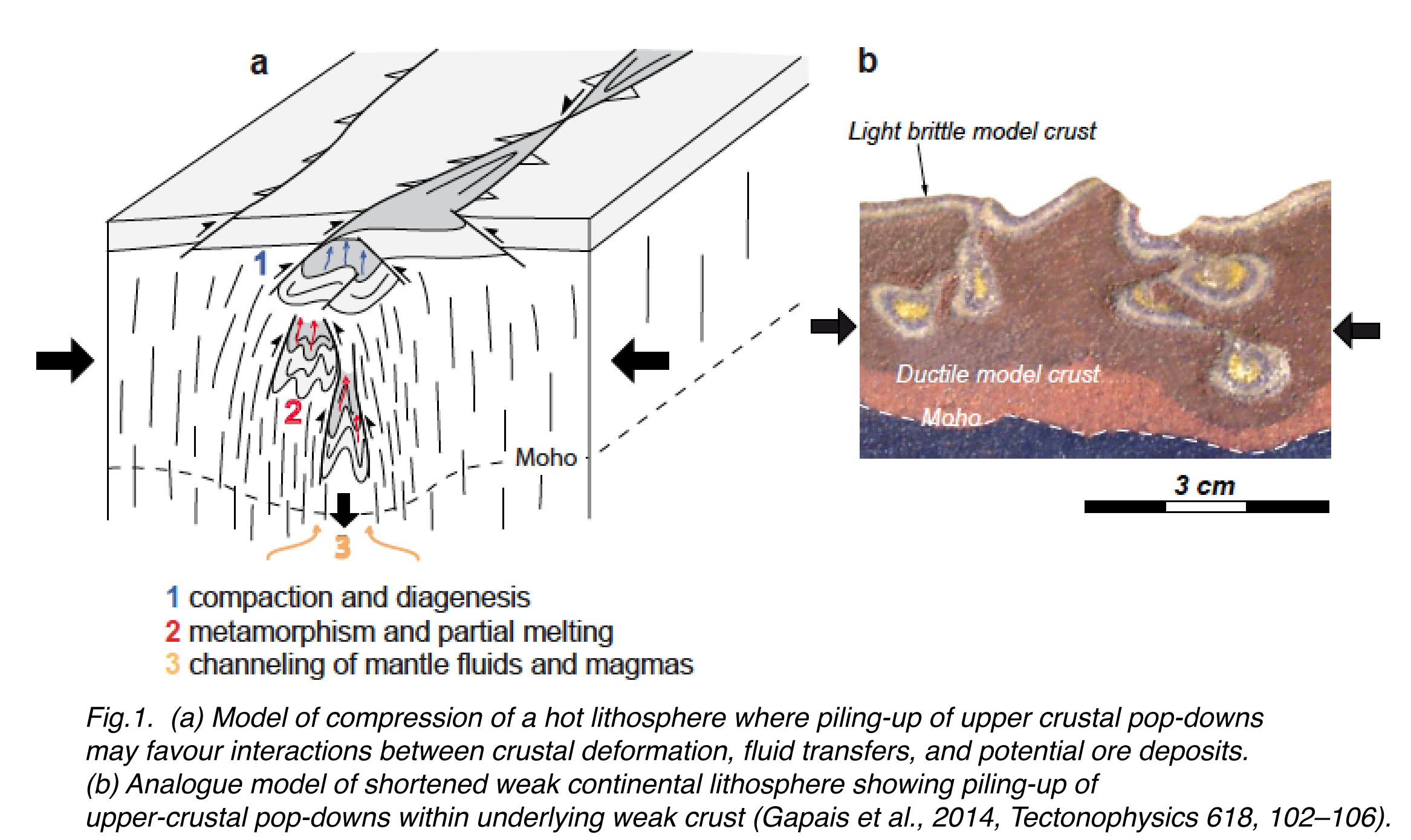
Back to: Archean Tectonics I