
Application of Biochemical modeling in Paleoclimatic reconstructions from tree ring cellulose isotope data
Application of Biochemical modeling in Paleoclimatic reconstructions from tree ring cellulose isotope data
Abstract ID#: 34449
English Abstract:
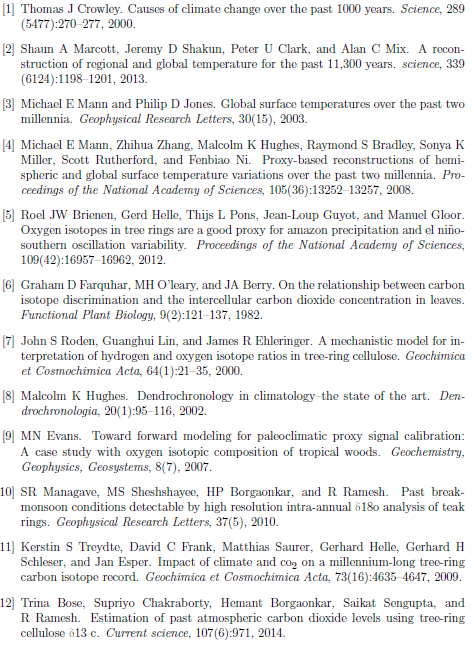
Present scenario of climate change has lead to the requirement of detail knowledge of the climate system, long term climate change, its different components and their interactions [1,2]. One of the primary sources of climatic variability information in recent past are the tree ring cellulose isotope datasets due to their stable temporal resolution[3,4,5]. However the reconstructions produced from such data have variable dependabilities due to their site and species specificness in terms of parameter reconstructed and the calibration[1]. There are myriad reasons of statistical regressions having limited correlation with instrumental data, e.g. nearest meteorological station data might be hundreds of kms away. In some cases correlation are higher due to complex statistics applied but this does not remove the site specific characteristics of these analyses.
Cellulose formation in all of the trees is mostly the same basic physiochemical process as they all undergo C3 metabolic process. This process and resultant isotopic fractionation have been modeled from experimental information on live trees[6,7,8]. Evans[9] used these relations as forward models to determine isotopic values of wood cellulose. Managave et al[10] tested similar forward models for a trial and error interpretation of the unknown inputs. Although some papers e.g.[11] identified some processes in long term data, but no process based reconstructions were given till now.
Among many benefits of process based reconstruction models, the primary is that the parameter being reconstructed and their dependabilities will stay constant in time and space. This will make the resultant reconstructions more easily interpreted in terms of observed physical processes in present and their variabilities in the past.
In presence of basic meteorological data i.e. temperature and humidity estimates,
the pCO2 has been reconstructed from carbon isotope data from tree ring cellulose[12]. The processes involving oxygen and hydrogen isotope fractionations provide information about humidity, temperature and source water isotopic compositions. Some of these process based fractionation models along with resultant reconstructions from them will be discussed.
Cellulose formation in all of the trees is mostly the same basic physiochemical process as they all undergo C3 metabolic process. This process and resultant isotopic fractionation have been modeled from experimental information on live trees[6,7,8]. Evans[9] used these relations as forward models to determine isotopic values of wood cellulose. Managave et al[10] tested similar forward models for a trial and error interpretation of the unknown inputs. Although some papers e.g.[11] identified some processes in long term data, but no process based reconstructions were given till now.
Among many benefits of process based reconstruction models, the primary is that the parameter being reconstructed and their dependabilities will stay constant in time and space. This will make the resultant reconstructions more easily interpreted in terms of observed physical processes in present and their variabilities in the past.
In presence of basic meteorological data i.e. temperature and humidity estimates,
the pCO2 has been reconstructed from carbon isotope data from tree ring cellulose[12]. The processes involving oxygen and hydrogen isotope fractionations provide information about humidity, temperature and source water isotopic compositions. Some of these process based fractionation models along with resultant reconstructions from them will be discussed.