Simulating Regional Impacts of Climate Change Mitigation Policies on the Global Timber Market: Implications for Regional Forest Management
Previously Published Material: The global vegetation simulation, which drives the global timber market analysis, was presented at the International Union of Forest Research Organizations (IUFRO) World Congress 2014 in Salt Lake City, UT. The proposed talk will cover the global vegetation simulation, its link to the global timber market analysis model, and the final results of the global timber market analysis.
Abstract ID#: 34516
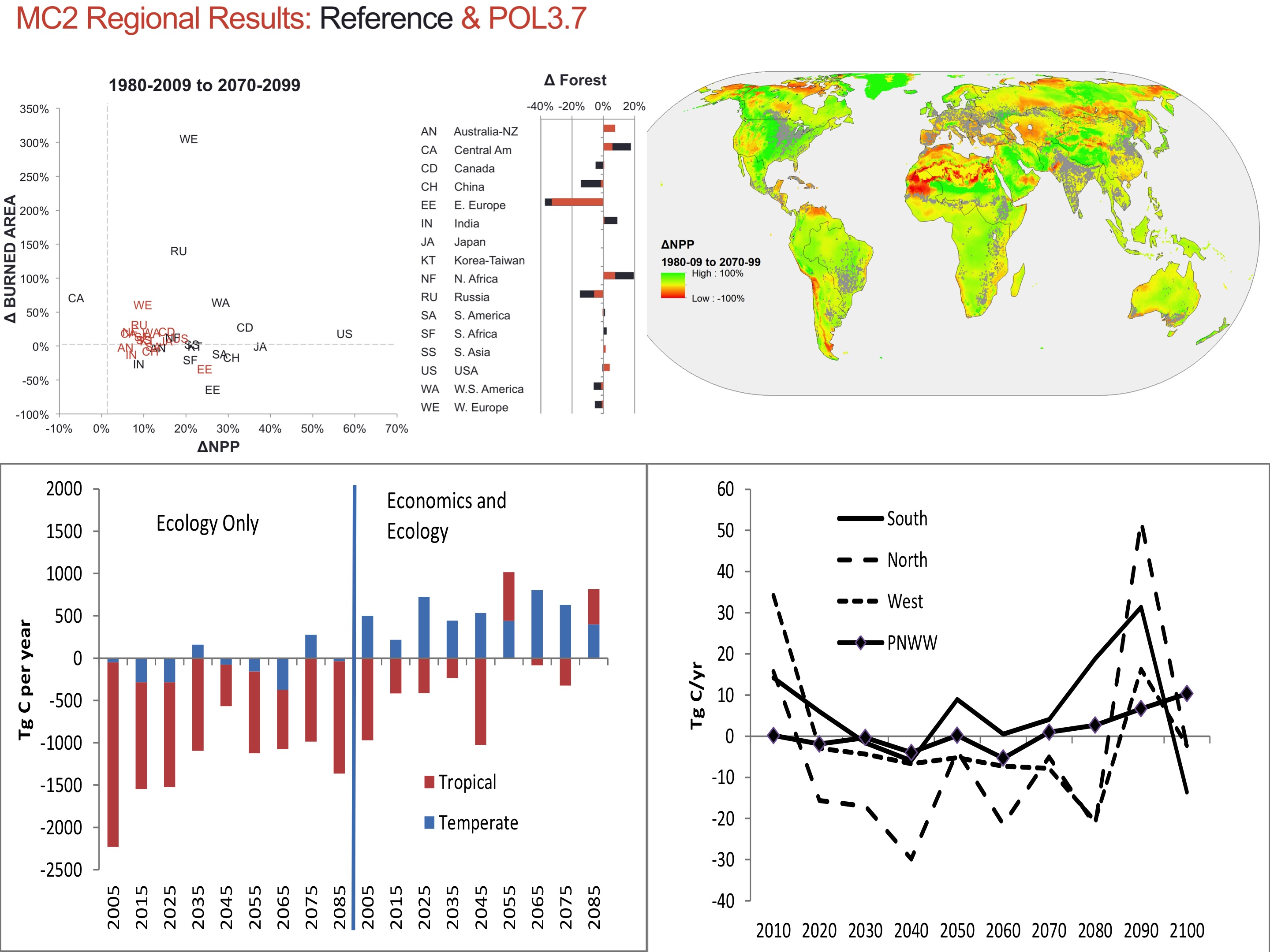
As a part of the Climate Change Impacts and Risk Analysis (CIRA) project by the U.S. EPA Climate Change Division, we integrated climate, vegetation and timber market models to estimate regional implications of global mitigation policies. The Emissions Predictions and Policy Analysis (EPPA) model and the Integrated Global System Model (IGSM) created three socioeconomic & emissions scenarios: Business-as -usual and two mitigation policy scenarios that stabilize radiative forcing levels in 2100. NCAR Community Atmospheric Model (CAM) linked to the IGSM generated 10 future climate projections. MC2 DGVM was run using the 10 climate projections, and the biophysical results from these models were used as boundary conditions for a global forestry and land use model (GTM). The resulting integrated climate-vegetation-economic modeling system is used to assess the implications of the three socioeconomic & emissions scenarios on various forest stocks, prices, and land use. Using the model, we estimate the regional impact of global mitigation policies on regions within the United States; explore the implications on regional forest mitigation policy; and assess the economic efficiency of alternative adaptation policies for the United States.