A Structural Molar Volume Model for Oxide Melts
A Structural Molar Volume Model for Oxide Melts
Abstract ID#: 34555
English Abstract:
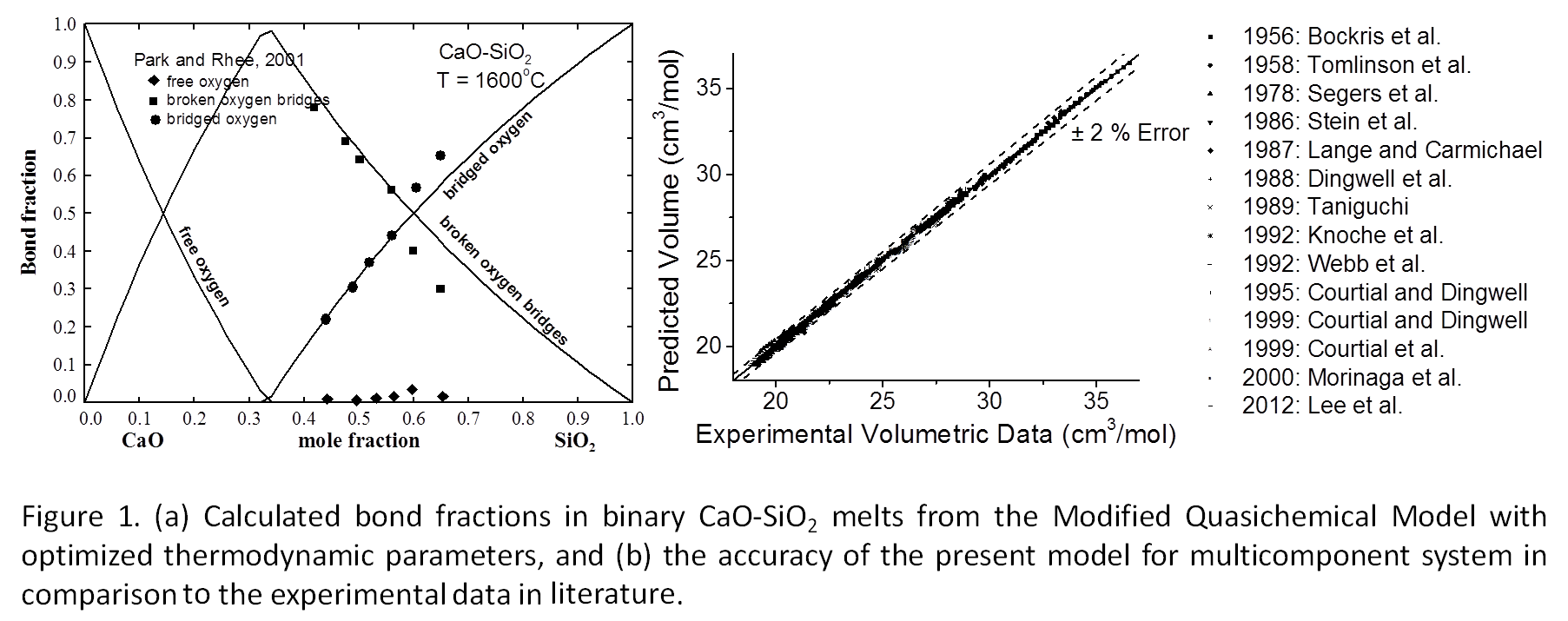
The molar volume of an oxide melt is determined by its atomic packing which is a function of bond lengths, orientation, and atomic scale interactions. Molar volume is a calculated property obtained from density and composition measurements. The molar volumes of metallurgical slags and geological melts in particular, are difficult to determine due to the extreme experimental conditions required. Modeling the available experimental data with semi-empirical models reproduces the available experimental data while also providing meaningful predictions to composition ranges where no experimental measurements currently exist. Typically, in the geological literature, linear molar volume models are used. However, linear models have been shown to reproduce the experimental data only within certain composition range. That is, a linear model is incapable of describing the molar volume of oxide melt in all composition ranges. In this work, a non-linear structural molar volume model was developed to accurately reproduce the molar volume of molten oxides, of importance for geological and metallurgical applications. In the present structural model, the silicate tetrahedral Q-species calculated from the Modified Quasichemical Model with the FactSage FToxid database were used as basic structural units and their unit volumes were used as binary model parameters along with the volume of pure oxides. All available experimental data for binary and ternary systems in the literature were critically evaluated based on their experimental techniques and experimental conditions to identify the most reliable data. From the optimized unary and binary model parameters, the present structural molar volume model can accurately calculate the molar volume and thermal expansion of the Li2O-Na2O-K2O-MgO-CaO-MnO-PbO-Al2O3-SiO2 melts at any composition and temperature under 1 atmosphere pressure.