Generalized Radiative Transfer Theory – An Efficient Model for 3D Domain- and/or Spectrally-Averaged Fluxes and Radiances Implemented in a Markov Chain Formalism
French Title: La Théorie du Transfert Radiatif Généralisé – Un Modèle 1D Efficace pour Flux et Radiances 3D en Moyenne Spatiale et/ou Spectrale Mis en Application via le Formalisme des Chaînes de Markov
Previously Published Material: recently accepted by a scientific journal:A.B. Davis & F. Xu, A generalized linear transport model forspatially correlated stochastic media, J. Comput. Theor. Transport 43, 474-514 (2014).
Abstract ID#: 34676
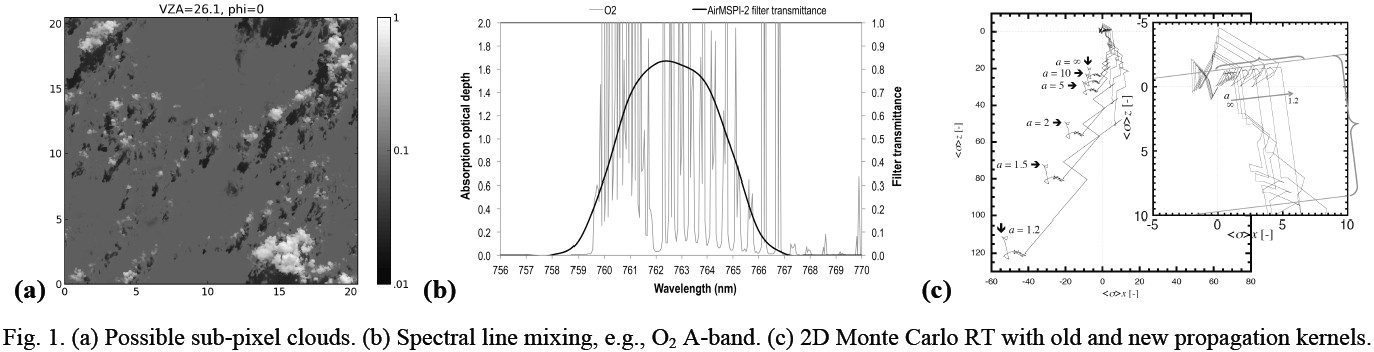
The inherently integral formulation of the GRT equation looks just like the standard form for a uniform plane-parallel optical medium. However, the spatial propagation part of the kernel has been generalized. In random media with spatial correlations over a broad range of scales that includes the photon mean-free-path, it decays as a power-law parameterized by a characteristic exponent a (cf. Fig. 1c). In the limit a→∞, the standard (Beer's) exponential law is recovered. We have developed both Monte Carlo and deterministic (specifically, Markov chain) schemes for solving the integral GRT equation. We have also obtained analytic results in the asymptotic limits of optically thin and thick media, in terms of their domain/ensemble-average optical thickness.
GRT correctly predicts increased transmittance with increasing variability parameter a–1. In congruence with previous theoretical, empirical and numerical findings, GRT in plane-parallel media violates angular reciprocity. Finally, an independent investigation of unresolved spectral variability (cf. Fig. 1b) has serendipitously arrived the same power-law propagation kernel, but it was only exercised in the absence of scattering [2]. This makes our GRT model a natural extension of that spectral modeling for scattering as well as absorbing media, and thus opens the possibility of accounting simultaneously for unresolved spectral and spatial variabilities.
[1] A.B. Davis & F. Xu, A generalized linear transport model for spatially correlated stochastic media, J. Comput. Theor. Transport 43, 474-514 (2014).
[2] A.J. Conley & W.D. Collins, Extension of the weak-line approximation and application to correlated-k methods, J. Quant. Spectrosc. Radiat. Transfer 112, 1525-1532 (2011).
Figure: