Identifying “Pristine” Craters on Mars: Defining Criteria and Characteristics
Livio L Tornabene, University of Western Ontario, London, ON, Canada, Jennifer L Piatek, Central Connecticut State University, Department of Geological Sciences, New Britain, CT, United States, Nadine G Barlow, Northern Arizona University, Flagstaff, AZ, United States, Joseph M Boyce, HIGP, Honolulu, HI, United States, Peter J Mouginis-Mark, University of Hawaii at Manoa, Honolulu, HI, United States, Gordon R Osinski, University of Western Ontario, Earth Sciences, London, ON, Canada and Stuart J Robbins, Southwest Research Institute, Boulder, CO, United States
Contact First Author: Livio L Tornabene; ltornabe@uwo.ca
Previously Published Material: The research and results presented herein are also being presented at the Lunar and Planetary Science Conference in March 2015.
English Abstract:
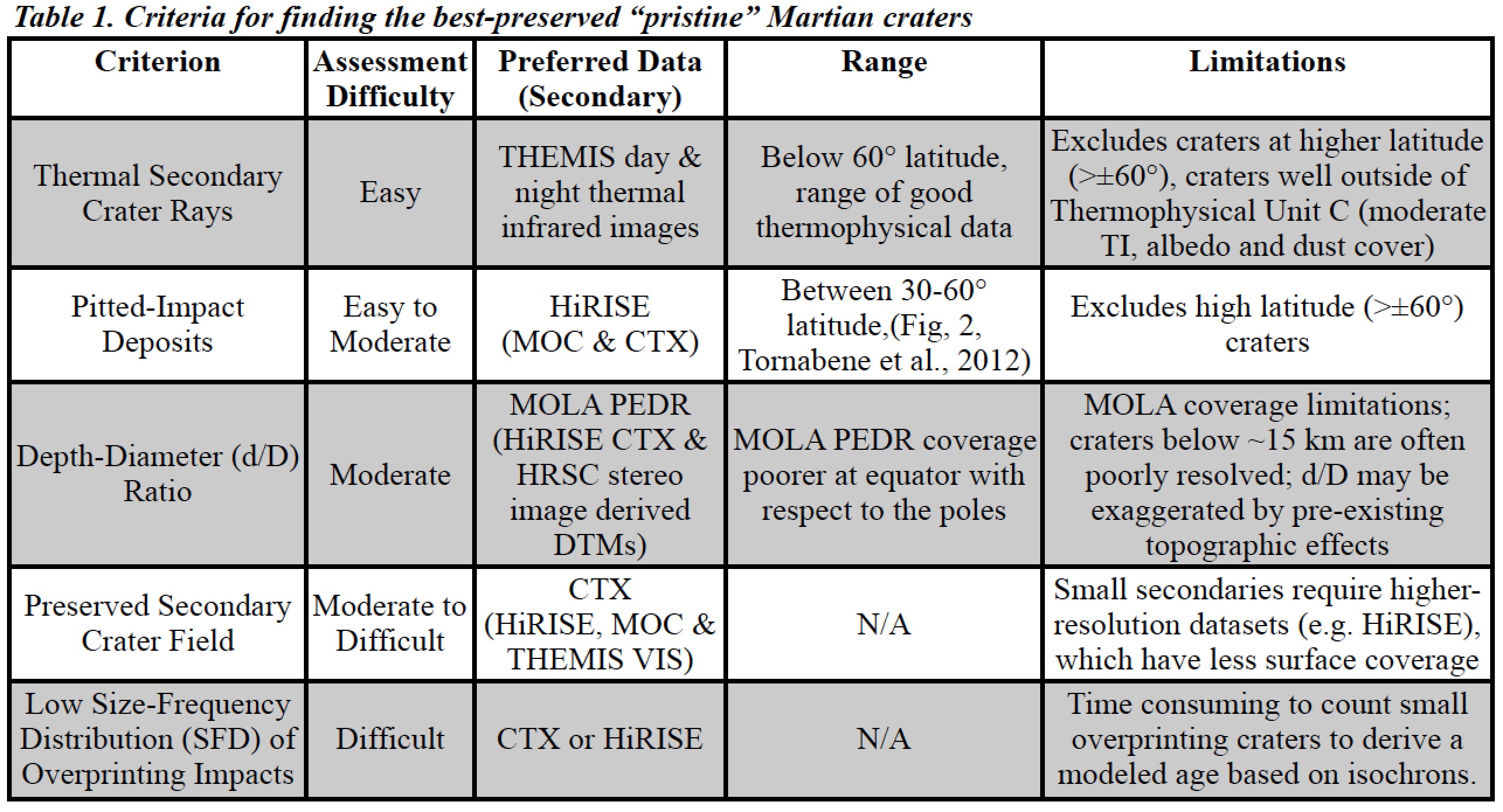
High-resolution meter-scale images of what are thought to be the youngest and best-preserved impact craters on Mars suggest that even the youngest craters on Mars show signs of modification by active geologic processes. As such, in order to constrain impact processes (e.g., ejecta properties and emplacement) and modification processes (i.e., various erosion and depositional processes), the visible and thermophysical characteristics of the most “pristine” craters on Mars must be constrained as a baseline. Indeed, various preservation/age terms (e.g., fresh, young, pristine, etc.) are used in the literature for Martian craters and often do not account for the fact that crater preservation and age may not be correlated. This is the case on a planet with active geologic processes, such as Mars, that exhibit both temporal and geographic variation in modification rate.
The objective of this study is to identify and characterize a set of physical properties associated with pristine Martian craters that will be utilized as a baseline for further studies. These craters will provide the best means to: 1) place further constraints on various aspects of the impact processes, and 2) examine how the physical properties of craters change as the crater and ejecta are modified over time, and as a function of target material and latitude. Here we define a “pristine” crater as a one that is both young (age) and appears morphologically “fresh” (i.e., the least-modified). In addition, we have begun to devise a crater classification scheme that couples both preservation and age of craters, which will prove useful for continued studies.
In summary, by using a synthesis approach that combines observations from both visible and thermal datasets, we are identifying examples of the youngest and best-preserved craters on Mars (i.e., “pristine”). These craters will provide a critical baseline for understanding the impact process and utilizing craters as a gauge for understanding the evolution of the Martian surface and past climates on Mars.