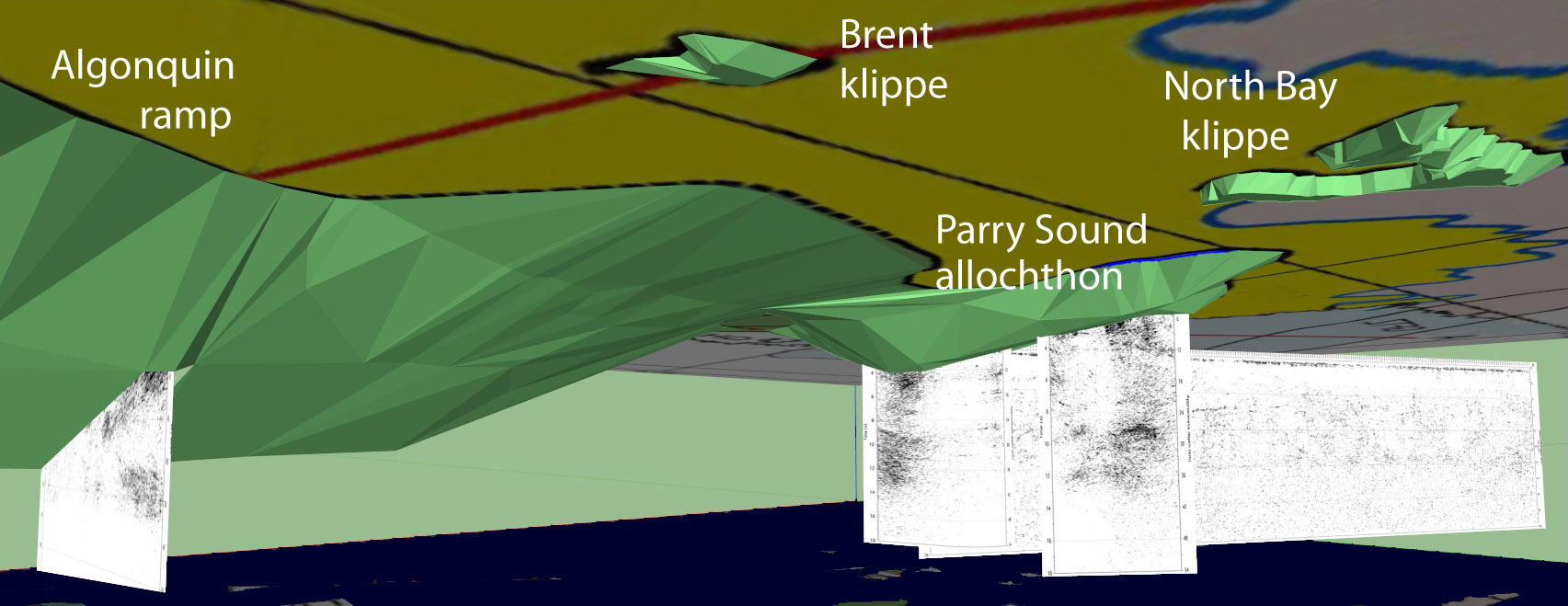
3D Visualization of the Large-Scale Crustal Structure in the SW Grenville Province
3D Visualization of the Large-Scale Crustal Structure in the SW Grenville Province
Abstract ID#: 35056
English Abstract:
An accurate understanding of the three-dimensional structure of orogenic belts is a prerequisite to a correct understanding of their tectonic history. However, the complexity of crustal architecture in the SW Grenville province has obscured a correct understanding of its structure, and hence of its geological evolution. The recognised locus of Ottawan-age crustal stacking during the Grenville Orogeny is the Allochthon Boundary Thrust (ABT), which separates laterally translated terranes to the southeast from largely in-situ terranes to the northwest. In the central and eastern Grenville province, the ABT acts as a crustal-scale ramp, up which high grade gneisses were exhumed before further sub-horizontal transport to the northwest. In contrast, the ‘standard’ model for the Grenville Province in Ontario and western Quebec interprets the ABT as a very long ramp with gentle southeasterly dip, extending across much of the outcrop width of the Central Gneiss Belt. However, Nd isotope mapping suggests that parautochthonous crust extends much further south than previously recognized, such that salients and windows of parautochthonous crust are recognised east of Whitney and south of Gravenhurst, between major allochthonous thrust sheets and erosional klippen. This implies a ramp-flat crustal structure in the SW Grenville Province, which can be understood with the aid of 3D visualization. This allows the complex three-dimensional shape of the ABT to be explored and compared with the attitude of other ramp surfaces of different ages, such as the Central Metasedimentary Belt Boundary Zone (CMBBZ) and the Grenville Front. The attached image shows a visualisation of the ABT surface (pale green) from a viewpoint in the mid crust, looking from Quebec towards the southwest, across the Central Gneiss Belt of Ontario. The yellow ground surface represents Paleoproterozoic crust.