
High Resolution Geodynamo Simulations with Strongly-driven Convection and Low Viscosity
High Resolution Geodynamo Simulations with Strongly-driven Convection and Low Viscosity
French Title: Simulations haute résolution de la géodynamo avec convection vigoureuse et viscosité faible.
Previously Published Material: These findings will also be presented at the EGU meeting in april 2015.They have already been presented in two workshops in 2014.No paper has been submitted yet, but I hope it will be submitted by then !
Abstract ID#: 35086
English Abstract:
Numerical simulations have been successful at explaining the magnetic field of the Earth for 20 years. However, the regime in which these simulations operate is in many respect very far from what is expected in the Earth's core. By reviewing previous work, we find that it appears difficult to have both low viscosity (low magnetic Prandtl number) and strong magnetic fields in numerical models (large ratio of magnetic over kinetic energy, a.k.a inverse squared Alfvén number).
In order to understand better the dynamics and turbulence of the core, we have run a series of 3 simulations, with increasingly demanding parameters. The last simulation is at the limit of what nowadays codes can do on current super computers, with a resolution of 2688 grid points in longitude, 1344 in latitude, and 1024 radial levels.
We will show various features of these numerical simulations, including what appears as trends when pushing the parameters toward the one of the Earth.
The dynamics is very rich. From short time scales to large time scales, we observe at large scales: Inertial Waves, Torsional Alfvén Waves, columnar convective overturn dynamics and long-term thermal winds. In addition, the dynamics inside and outside the tangent cylinder seem to follow different routes.
We find that the ohmic dissipation largely dominates the viscous one and that the magnetic energy dominates the kinetic energy. The magnetic field seems to play an ambiguous role. Despite the large magnetic field, which has an important impact on the flow, we find that the force balance for the mean flow is a thermal wind balance, and that the scale of convective cells is still dominated by viscous effects.
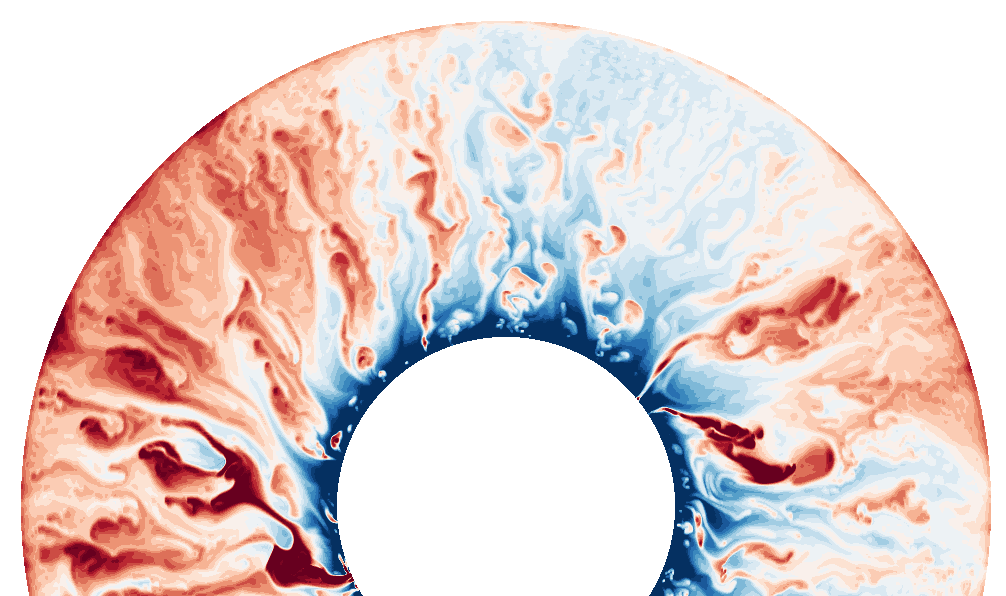
In order to understand better the dynamics and turbulence of the core, we have run a series of 3 simulations, with increasingly demanding parameters. The last simulation is at the limit of what nowadays codes can do on current super computers, with a resolution of 2688 grid points in longitude, 1344 in latitude, and 1024 radial levels.
We will show various features of these numerical simulations, including what appears as trends when pushing the parameters toward the one of the Earth.
The dynamics is very rich. From short time scales to large time scales, we observe at large scales: Inertial Waves, Torsional Alfvén Waves, columnar convective overturn dynamics and long-term thermal winds. In addition, the dynamics inside and outside the tangent cylinder seem to follow different routes.
We find that the ohmic dissipation largely dominates the viscous one and that the magnetic energy dominates the kinetic energy. The magnetic field seems to play an ambiguous role. Despite the large magnetic field, which has an important impact on the flow, we find that the force balance for the mean flow is a thermal wind balance, and that the scale of convective cells is still dominated by viscous effects.