Some remarks on global tectonics of Enceladus
Previously Published Material: Parts of the results are presented in EGU 2014.
Abstract ID#: 35442
The loss of matter from the body’s interior should lead to global compression of the crust. Typical effects of compression are: thrust faults, folding and subduction. However, such forms are not dominant on Enceladus. We propose here special tectonic model that could explain this paradox.
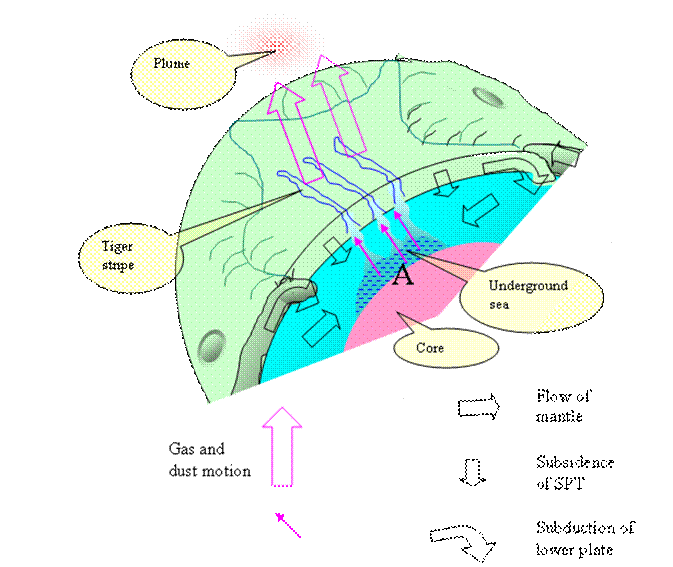
We consider here hypotheses stating that the mass loss from SPT is the main driving force of the following tectonic processes: subsidence of SPT, flow in the mantle and motion of plates. It is an extension of [2] and [3].
The numerical model is developed. It is based on the equations of continuous media. We found that the loss of the volatiles results in a void, an instability, and motion of solid matter into the hot region to fill the void.The motion is presented at the Figure and includes:
(i) Subsidence of the ‘lithosphere’ of SPT.
(ii) Flow of the matter in the mantle.
(iii) Motion of plates adjacent to SPT towards the active region.
If emerging void is being filled by the subsidence of SPT only, then the velocity of subsidence is ~0.05 mm·yr-1. However, all three types of motion are probably important, so the subsidence is slower but mantle flow and plates’ motion also play a role in filling the void. The preliminary results of the numerical model indicate that the the subsidence rate of ~0.05 mm·yr-1 is possible if we assume Newtonian rheology.
Note that in our model the reduction of the crust area is not a result of compression but of the plate sinking. Therefore the compressional features do not have to be dominant. Experimental model is developed to investigate the surface effects of the subsidence. I
Acknowledgement: The research is partly supported by National Science Centre (grant 2011/ 01/ B/ ST10/06653).
References
[1] Spencer, J. R., et al. Enceladus: An Active Cryovolcanic Satellite, in: M.K. Dougherty et al. (eds.), Saturn from Cassini-Huygens, Springer Science, (2009), p. 683.
[2] Czechowski, L., Enceladus - the vanishing satellite presenting in EGU 2014, Vienna.
[3] Czechowski, L., Some remarks on the early evolution of Enceladus. Planet. Sp. Sc. 104, 185-199 (2014).