The Age of the Carswell Impact Structure
Abstract ID#: 35478
Some important questions remain: 1) when was the exact onset of this event; 2) are there any big impact structures related to this event that remain in the geological record; and, if so, 3) how did the Earth system respond to these larger impacts?
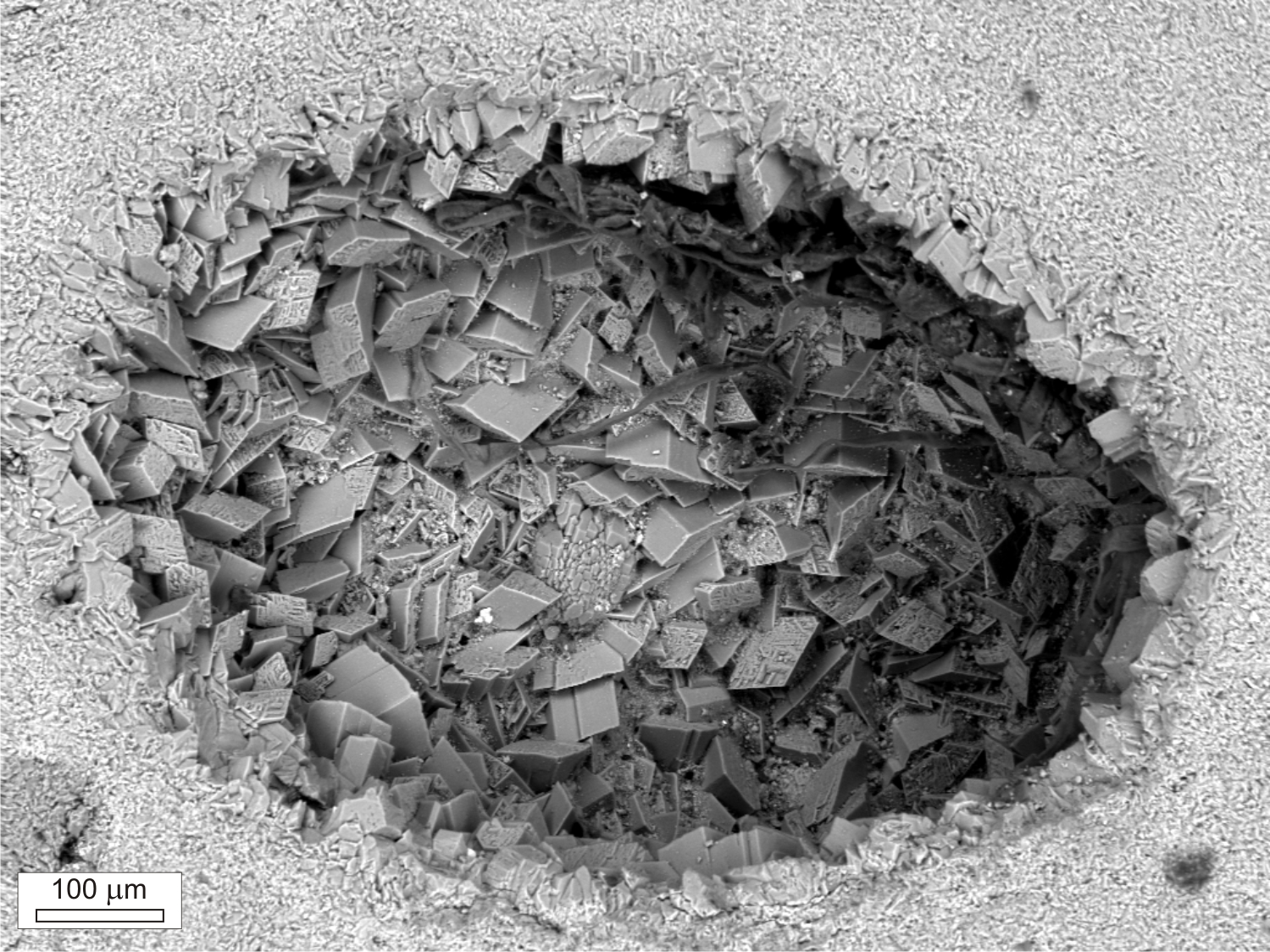
In Canada, potential candidates for larger impact structures of approximately the right age are Carswell, Slate Islands, and possibly Charlevoix. None of these structures is well dated. Here we address the age of the large (~40 km) Carswell structure, which impacted the Paleo- to Mesoproterozoic Athabasca Basin of northern Saskatchewan. We have collected a suite of impact breccias from in and around the central core of the structure, ranging from fully melted and quenched melt rocks to partially melted pseudotachylites and intensely brecciated basement rocks. All contain shock features. Some of the breccias that show advanced melting contain gas vesicles formed during post-impact quenching and crystallization. These vesicles are lined with pristine quartz and adularia crystals (see image: mid-grey triclinic rhombs are adularia). It is from these pristine adularia crystals that we have obtained high-quality Ar-Ar plateau ages of 481±1 Ma. This age records the cooling and hydrothermal activity in the target area, immediately post-impact.
The precise adularia age of 481 Ma finally dates the large Carswell impact. Although we do not yet know the nature of the impactor, it appears that this large impact is remarkably close in time, but nevertheless ~5-10 Myr too old, relative to the accepted onset of the L-chondrite impact event.
References: [1] Bleeker, 2011, GAC Annual Meeting, Ottawa, Abstract vol. 34, p. 19; [2] Korochantseva et al., 2007, Meteoritics & Planetary Science, vol. 41, p. 113-130; [3] Ormö et al., 2014, Scientific Reports, vol. 4, article no. 6724.