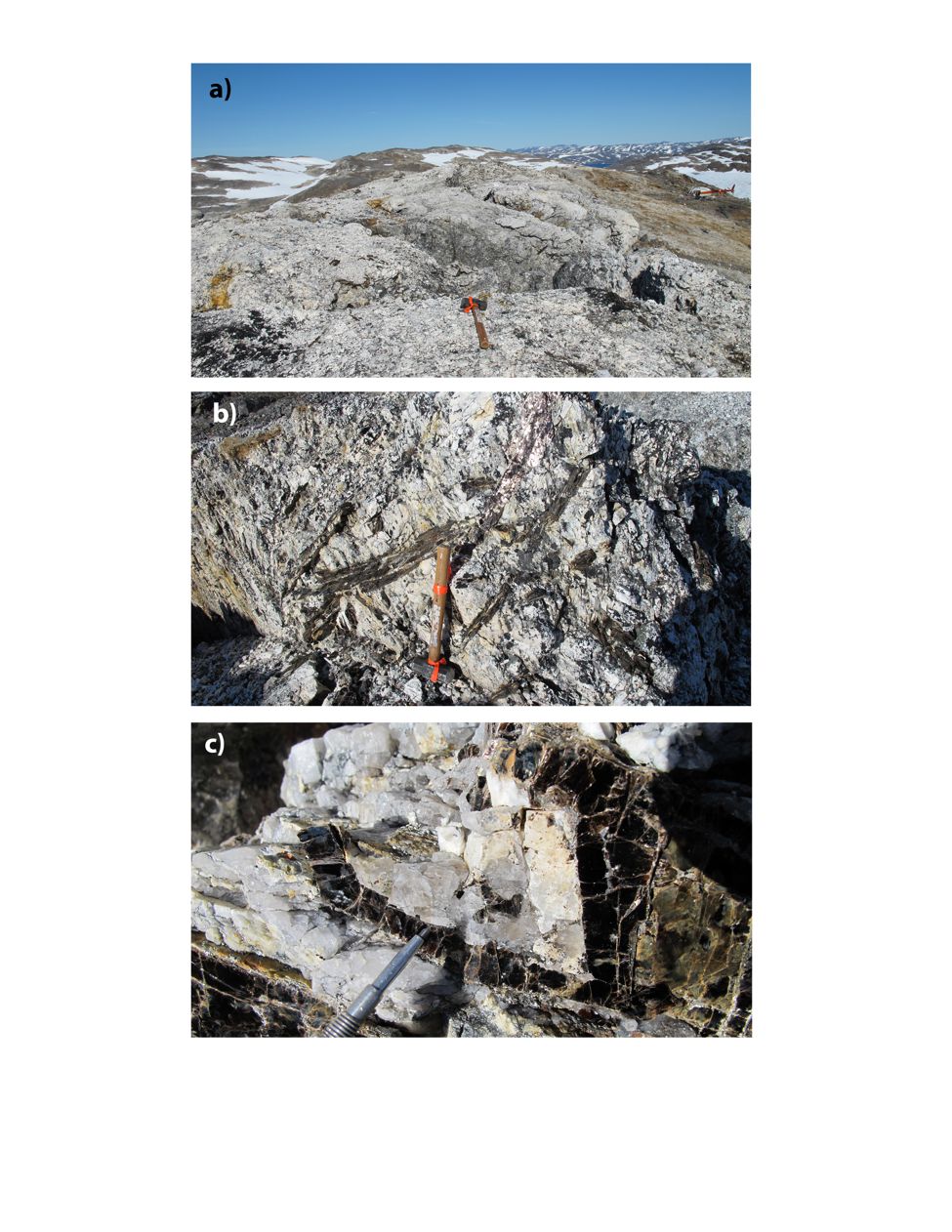
Location and Characterization of Pegmatites in the Southern Baffin Island Region, Nunavut: Field and Satellite Observations
Previously Published Material: The paper on which this poster is based will have been published by the time the conference occurs, in the Summary of Activities 2014, Canada-Nunavut Geoscience Office.
Abstract ID#: 36584
This project will also include an examination of the source of parent melts, relative paragenesis, timing with respect to late orogenic evolution, and absolute ages of emplacement. Lithogeochemical and mineral-chemical analysis of the pegmatites is being done using whole-rock geochemistry and laser-ablation, multiple-collector, inductively coupled plasma–mass spectrometry (LA-MC-ICP-MS). In-situ field analysis of pegmatites for higher-than-background radioactivity also took place using a GR-135 Plus spectrometer in order to prioritize pegmatites for geochronological work.
A broader regional context has been added to this project through the use of pegmatite samples obtained from both the Cumberland and Meta Incognita peninsulas. As pegmatites are not generally large targets, and can be easily overlooked in larger scale mapping projects, an attempt is being made to develop an approach that can identify them using various remote sensing methods.