Climate sensitivity and modeling of vegetation distribution through trait-climate relationships in China
Climate sensitivity and modeling of vegetation distribution through trait-climate relationships in China
Previously Published Material: this paper has not submitted in any journal
Abstract ID#: 33727
English Abstract:
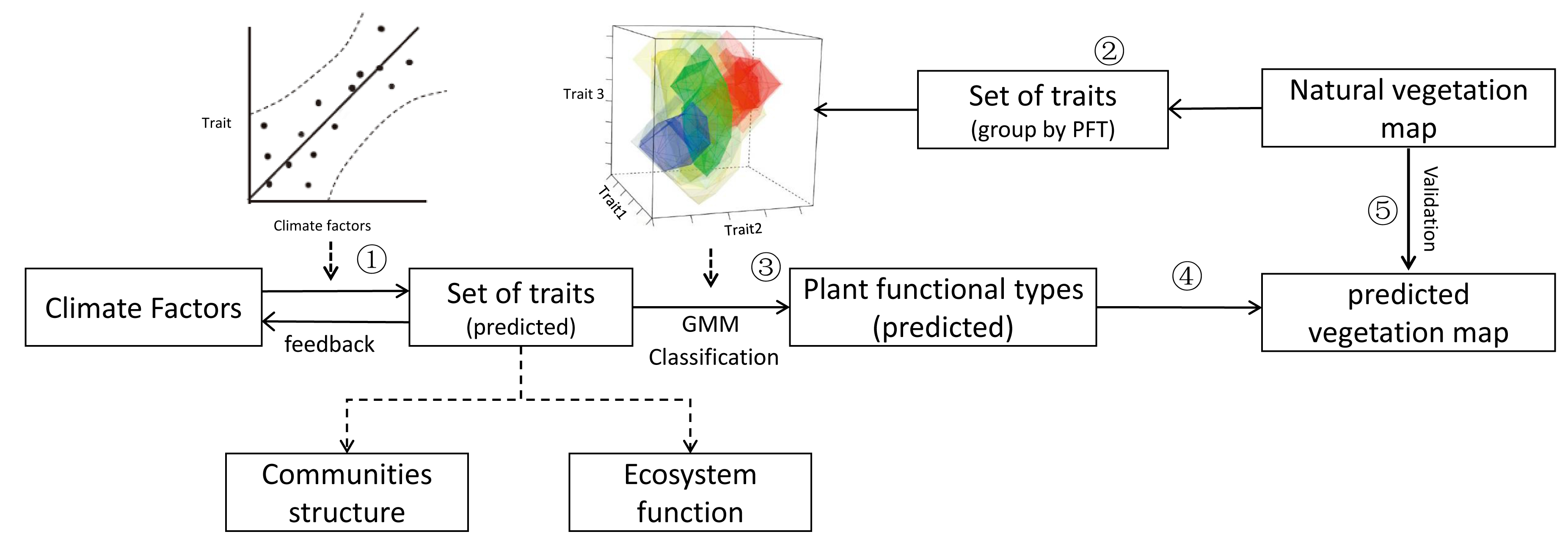
As a part of ongoing development of plant functional traits (FTs) hybrid model, Gaussian Mixture Model (GMM) has been applied for predicting the vegetation distribution and investigating the sensitivity of vegetation to changing climate conditions based on trait-climate relationships in China. Firstly, we have collected three key plant functional traits (FTs) including leaf mass per area (LMA), area-based leaf nitrogen (Narea), mass-based leaf nitrogen (Nmass) from published papers and available literatures as well as one structural trait of plant community - leaf area index (LAI) extracted from MODIS products across China. Secondly, we have derived and developed the trait-climate relationships and used different trait combinations to train GMM for vegetation classification. Finally, the GMM trained by LMA-Nmass-LAI combination was applied to investigate the climate sensitivity of vegetation under different climate scenarios in China. The results showed that (1) all four traits are well captured the relationships between climate variables and traits and work well in predicting the vegetation distribution and analyzing the environmental sensitivity; (2) the LMA-Nmass-LAI combination with a accuracy of 72%, which could provide more parameters information about communities structure and ecosystem function was selected to train GMM for predicting the vegetation distribution; (3) Sensitivity analysis indicated that increasing temperature shifted boundaries of most vegetation northward and westward; for the reason that forest is more suitable for growing in rainy conditions, increasing precipitation expanded the boundaries of forest to a larger area compared with baseline vegetation distribution. Despite limitations and uncertainties in using plant trait-climate relationships to predict future vegetation dynamics under different climate conditions, it laid a good foundation and demonstrated a great potential for constructing the next generation of DGVMs based on FTs and would provide more flexible approaches in modeling global vegetation dynamics under a changing climate.