Temporal Redox Fluctuations in Sediments: Pulsed Phosphorus Loadings in Freshwater Marsh Systems?
French Title: Les fluctuations temporelles du redox dans les sédiments: les chargements du phosphore pulsé dans les systemes de marais d'eau douce
Abstract ID#: 34323
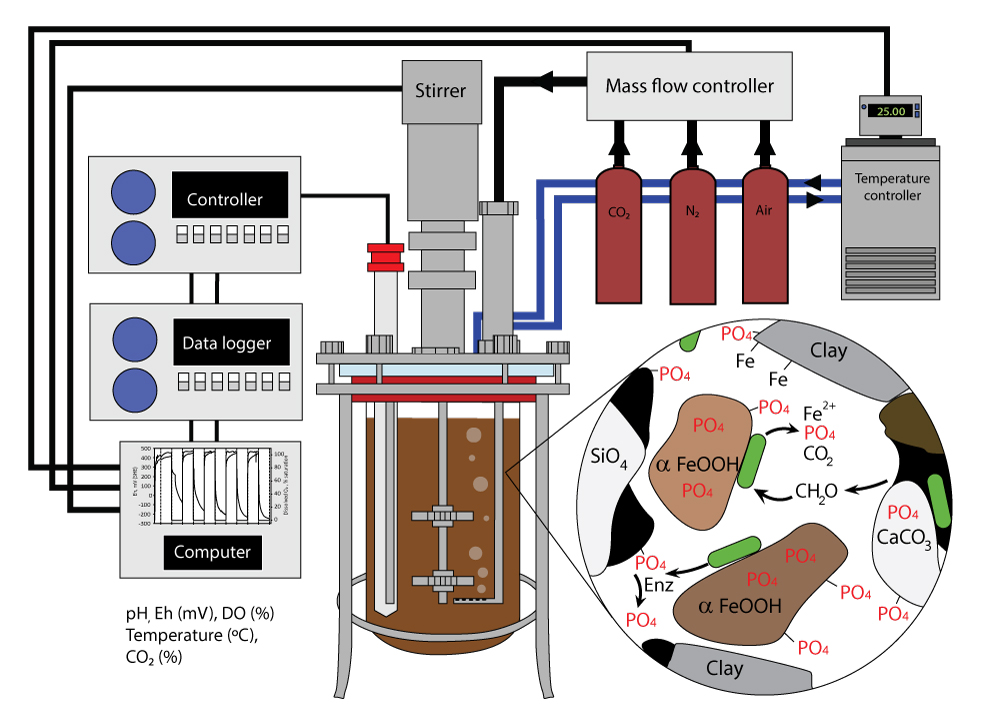
Results from bioreactor experiments show that repetitive re-oxidation of surficial wetland sediment (0-15cm) results in rapid degradation of organic phosphorus species (Po) in autochthonous algal material to orthophosphate. Therefore, there is little accumulation of Po in sediments (Po = 13% of total sediment P). Despite enhanced extracellular phosphatase activities under oxic conditions (e.g. phosphomonoesterase activity of 2.4 mmol hr-1 kg-1), maximum phosphorus mobilization occurs during reducing conditions due to a strong metal oxide control. Reductive dissolution of iron oxides under anoxic conditions results in the reversible redistribution of iron oxide bound P to other solid phase pools and the aqueous phase.
Preliminary in situ mesocosms suggest that diurnal cycling of dissolved oxygen concentrations, controlled by photosynthesis and respiration, does not exert a strong influence on internal phosphorus loading to surface water. This is due to excessive nitrate concentrations (~200 µM) in surface water which inhibit iron reduction at the sediment water interface during short periods of water column anoxia and prevent pulsed phosphorus release.