Physically Accurate Soil Freeze-Thaw Processes in a Global Land Surface Scheme
Previously Published Material: Preliminary Results were Presented at AGU Fall Meeting 2013
Abstract ID#: 34495
We incorporated soil freeze-thaw processes into an existing detailed model for the transfer of heat, liquid water and water vapor in soils, including isotope diagnostics – Soil-Litter-Iso (SLI, Haverd & Cuntz 2010), successfully used for water and carbon balances of the Australian continent (Haverd et al. 2013). A unique feature of SLI is that fluxes of energy and moisture are coupled using a single system of linear equations, a feature preserved in the extension to include freeze-thaw processes. The extended model is evaluated extensively in stand-alone mode (against theoretical predictions, lab experiments and field data) and as part of the CABLE global land surface scheme.
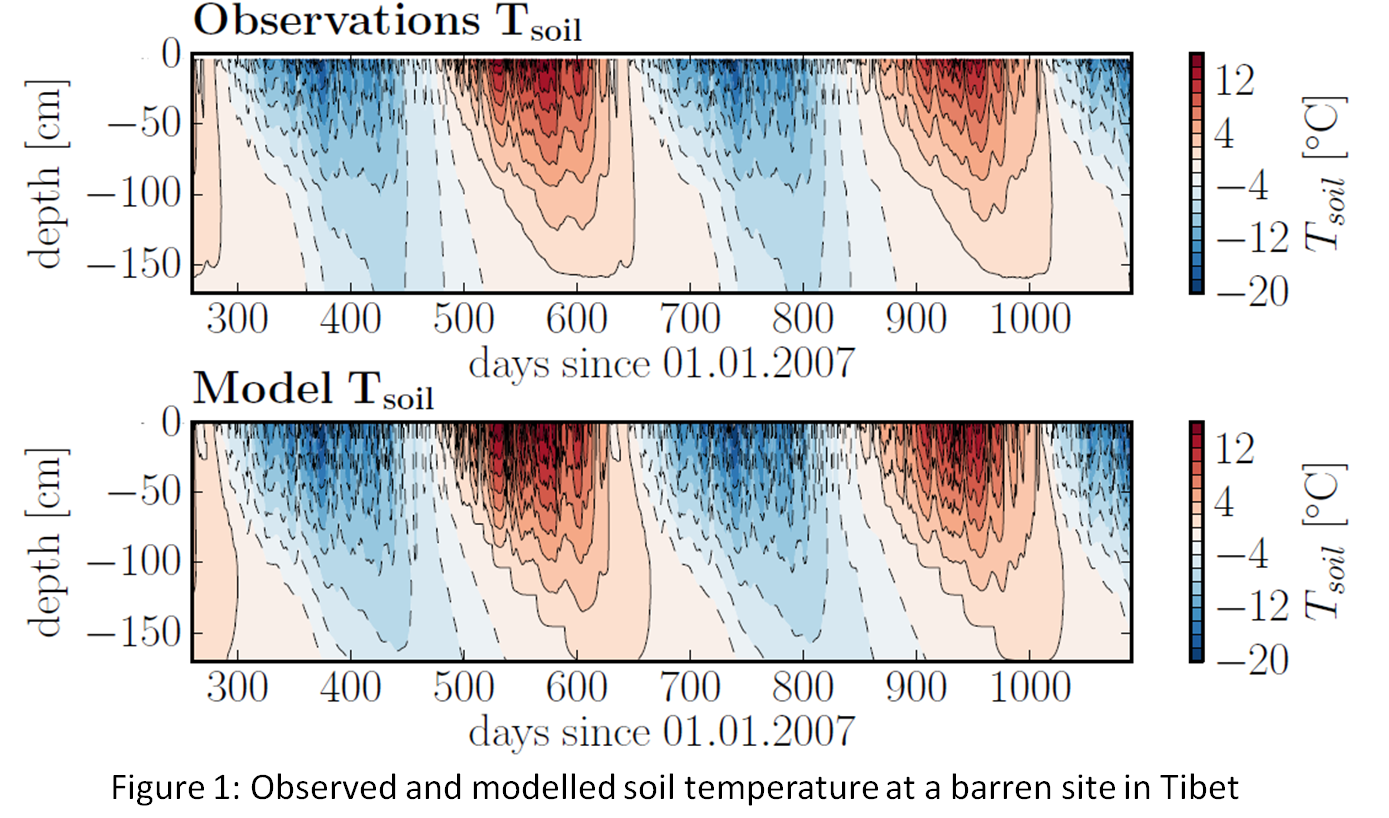
SLI accurately solves the classical Stefan problem of a homogeneous medium undergoing a phase change, and accurately reproduces observations of the freezing front from laboratory experiments (Hansson et al. 2004). Tests against observations at a permafrost site in Tibet (Weismüller et al. 2011) reproduce seasonal thawing and freezing of the active layer to within 3 K of the observed soil temperature (fig 1) and to within 10% of the observed volumetric liquid soil moisture. Tests in the presence of snow show good agreement with observed snow-water equivalents and soil temperatures, although refreezing of melted snow water is highly sensitive to the number of model snow layers, which influence density and temperature gradients in the snow-pack.
SLI was run globally on 1ºx1º grid as the soil part of the land surface scheme CABLE. We could therefore demonstrate that this detailed and physically-realistic formulation is fast enough to be a feasible alternative to the much simpler default soil-scheme in CABLE. Modeled northern hemisphere permafrost extent and depth are shown to be sensitive to incorporation of the soil freezing curve in the model.