Introducing Multi-Model Ensembles to Decision-Makers: The Perception Challenge
Introducing Multi-Model Ensembles to Decision-Makers: The Perception Challenge
French Title: L'enjeu de la perception des scénarios cllimatiques dans l'utilisation des ensembles multi-modèles par les décideurs
Previously Published Material: I've just submitted another abstract discussing the same case studies to the 22nd Canadian Hydrotechnical Conference. The point-of-view and audience are however completely different. For the CHC, attended by engineers, I'll focus on the mechanics of the investment analysis and the decision-making tools, whereas here I'll address the perception of climate model ensembles by decision-makers and how to present scenarios to this particular crowd.
Abstract ID#: 34914
English Abstract:
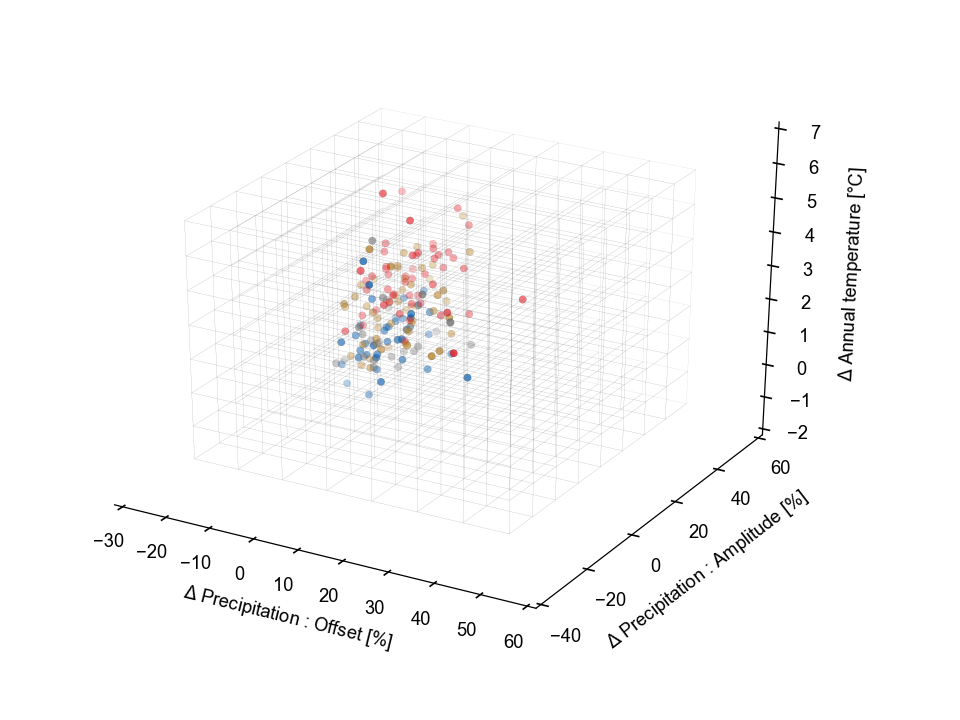
Large infrastructure investments in the hydroelectric sector are planned decades in advance and their economic returns evaluated over periods ranging up to a century. Such long time spans and the sensitivity of hydroelectric productivity to climatic conditions make those investments especially sensitive to uncertainties in climate projections. However, there are very few known examples of hydroelectric investments from private investors using climate projections to assess their robustness to future climate conditions. One explanation may be that typical top-down climate scenarios prepared for impacts and adaptation studies do not give decision-makers a solid footing to evaluate the climate risks, or opportunities, of a given project. Indeed, the large uncertainties around climate projections from multi-model ensembles may either be perceived by non-climatologists as an obstacle to their use in investment planning or as an indication of climate science's immaturity. In collaboration with Hydro-Québec and Manitoba-Hydro, Ouranos is developing decision-making tools for two case studies in the hydroelectricity sector. The aim of these studies is to show-case how climate information from multi-model ensembles can be leveraged by decision-makers. The approach uses the “Robust Decision Making” framework and explores the sensitivity of different investment options to climate projection uncertainty. Of particular interest within this framework is the role played by climate projections, where instead of defining future conditions through top-down scenarios, they play the role of expert advice, weighing in on the likelihood of parameterized climate scenarios. This fundamental switch in the interpretation and perception of climate projections may ease their integration into decision-making process by explicitly acknowledging their conditional nature.