METAMORPHIC AND STRUCTURAL INSIGHT FROM INVESTIGATIONS OF ELUSIVE AEROMAGNETIC ANOMALIES WITHIN THE CANADIAN SHIELD
METAMORPHIC AND STRUCTURAL INSIGHT FROM INVESTIGATIONS OF ELUSIVE AEROMAGNETIC ANOMALIES WITHIN THE CANADIAN SHIELD
Previously Published Material: Some of these findings have been publlished in Tectonophysics and were presented at NE GSA and GSA previously. However, new material is will be presented.
Abstract ID#: 35343
English Abstract:
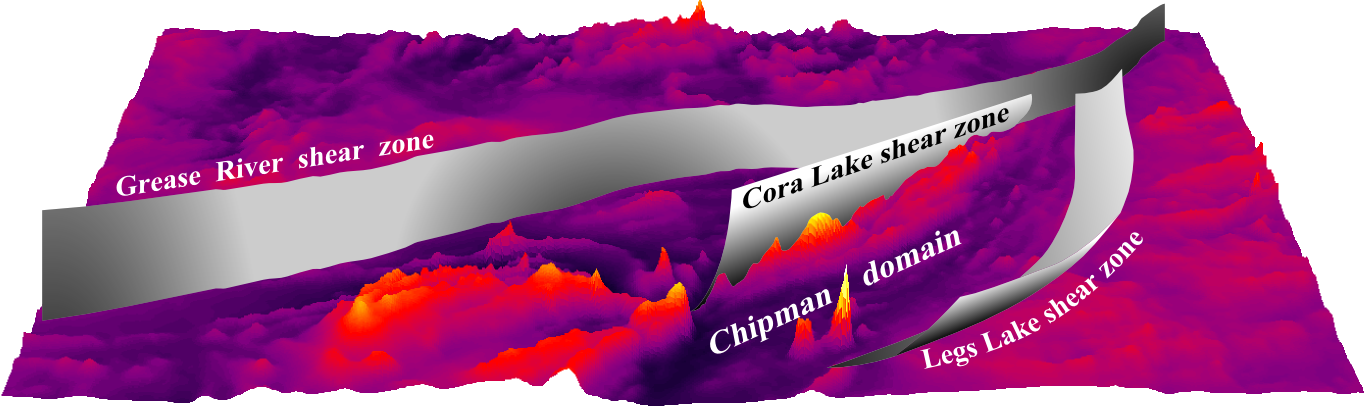
The acquisition of aeromagnetic data across the Canadian shield lead to a renaissance of Precambrian geology, from which crustal scale structures and lithotectonic domains where defined, correlated, and placed within a plate-tectonic framework. However, many local aeromagnetic anomalies do not directly correlate to changes in mapped lithology and are often overlooked. We suggest that many anomalies may reflect aspects of the metamorphic and structural history of a region that may be used to gain insight into crustal processes beyond simple map correlations. An excellent location to investigate this relationship is the the Chipman domain of the Athabasca granulite terrane due to the occurrence of significant aeromagnetic anomalies across a relatively homogeneous tonalitic batholith. The western portion of the domain is defined by a large plateau of elevated total field intensity. Volumetrically minor mafic dikes, lozenges, and schlieren hosted by the 3.2 Ga tonalite occur throughout the domain and display significant variations in magnetic susceptibility with observed values in excess of 0.5 SI to below 0.0005 SI. Although low magnetic susceptibilities occur throughout the entire domain, elevated values are restricted to the west. Investigations of isothermal remanent magnetization acquisition curves and analytical petrology indicate that variations in the volume percent of magnetite are likely responsible for most of these anomalies. Furthermore, the occurrence of magnetite is likely a function of metamorphic reactions, some of which involve hydration / dehydration. Two-dimensional finite element modeling of aeromagnetic anomalies supports the characterization of six petrophysically distinct domains with representative magnetic susceptibilities. We suggest that the western and eastern portions of the Chipman domain experienced distinct metamorphic histories that are expressed by the regional aeromagnetic data. Further characterization and modeling of magnetite-producing and consuming reactions will enable the correlation of local petrophysical observations to larger scale interpretations.